
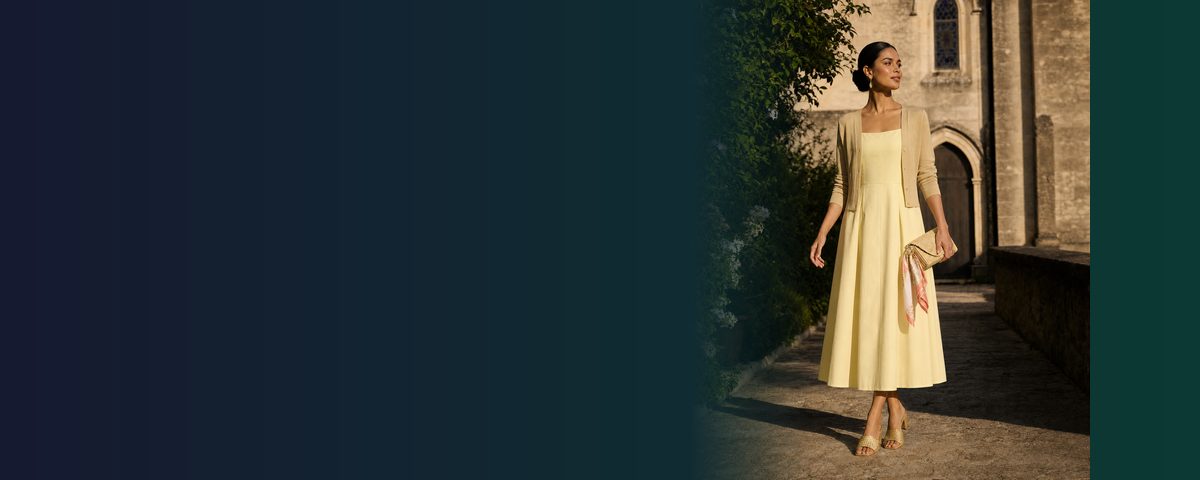
If your shoulders, bust and hips are all roughly the same width and your waist curves in only gently, you most likely have a rectangle body shape, also called straight, banana or H. It is the most common female body shape in large sizing studies, and it is one of the easiest to dress: you can build in a waist and a little curve, or lean into the clean, straight line that most runway clothes are cut for.
This guide covers both approaches in depth. You'll find a precise definition with measurements at four sizes, how to tell a rectangle from an hourglass, apple or inverted triangle, celebrity outfit breakdowns that explain why specific looks work, category-by-category advice from tops to outerwear, seven real outfit examples, four occasion formulas and a detailed FAQ.
Measure your bust, your natural waist and your hips. You have a rectangle shape if your bust and hips are within about 5% of each other and your waist is less than 25% narrower than both. As a waist-to-hip ratio (waist divided by hips), that usually lands between 0.80 and 0.90.
The quickest way to separate rectangle from hourglass: both have balanced bust and hips, but an hourglass waist is clearly nipped in (a ratio of about 0.70 to 0.75), while a rectangle waist is only softly defined. From the front, a rectangle reads as a fairly straight line from shoulder to hip.
What exactly defines a rectangle body shape
Like every body shape, the rectangle is defined by proportions rather than size. A size 6 and a size 20 can both be rectangles. The three markers are:
- Bust and hips are balanced, within about 5% of each other in circumference, exactly as on an hourglass
- The waist is only softly defined, less than 25% narrower than the bust and hips. As a waist-to-hip ratio, that usually lands between about 0.80 and 0.90
- Shoulders line up with the hips, so neither the top nor the bottom half is clearly the widest point and the frame reads as straight rather than tapering
To measure yourself, use a soft tape and stand relaxed. Take your bust at the fullest point, your natural waist at the narrowest point (usually about an inch above your navel), and your hips at the fullest point of your seat. Compare bust with hips first: if they are within about 5% of each other, you are either an hourglass or a rectangle. Then divide your waist by your hips. A result of roughly 0.80 or above points to a rectangle.
- UK 8 / US 4: bust 84cm, waist 69cm, hips 86cm (33–27–34 inches)
- UK 12 / US 8: bust 91cm, waist 76cm, hips 94cm (36–30–37 inches)
- UK 16 / US 12: bust 102cm, waist 85cm, hips 104cm (40–33½–41 inches)
- UK 20 / US 16: bust 112cm, waist 94cm, hips 115cm (44–37–45 inches)
In each set the bust and hips are within a few centimetres of each other, and the waist is only about 18–20% narrower than the hips, a ratio of 0.80 to 0.82. On an hourglass at the same sizes, the waist would be 25% or more narrower. That single difference is what separates the two shapes.
Rectangle, banana, straight, H: are they the same shape?
Yes. The naming is one of the most confusing things about body-shape guides, but rectangle, straight, banana, H and ruler all describe the same proportions: balanced bust and hips with a softly defined waist. "Rectangle" and "H" describe the outline geometrically, "banana" and "ruler" are informal, and "straight" is the term many stylists and pattern makers use. Nothing about the styling advice changes depending on which word a guide prefers.
Two related names are worth separating out. Square is sometimes used for a rectangle on a broader frame, with straight, squared shoulders. The styling is the same. Athletic is usually a rectangle on a lean or muscular build, but there is a catch: an athletic frame with broad, muscular shoulders that are clearly wider than the hips (often called a swimmer's build) is an inverted triangle, not a rectangle. Compare your shoulders with your hips to tell which you are.
Rectangle vs hourglass, apple and inverted triangle
Most people who are unsure of their shape are choosing between a rectangle and one of its three neighbours. The tie-breakers are simple:
- Rectangle vs hourglass: both have balanced bust and hips. Divide waist by hips. Below about 0.75 is hourglass, above about 0.80 is rectangle, and 0.75 to 0.80 is the overlap, where you can borrow waist-defining pieces from our hourglass guide and keep whatever reads best in the mirror.
- Rectangle vs apple: if your ratio creeps above 0.90, stand side-on to a mirror. A rectangle looks straight in profile, with weight spread evenly around the torso. An apple shows forward fullness at the stomach and usually a fuller upper body over slimmer legs.
- Rectangle vs inverted triangle: compare shoulders to hips, not the waist. If your shoulders or bust are more than about 5% wider than your hips, you are an inverted triangle, even if your waist barely curves.
- Rectangle vs slim pear: a pear on a slender frame is often misread as a rectangle because nothing looks curvy at first glance. If your hips measure more than about 5% larger than your bust, read the pear guide instead.
If you are still unsure, our overview of how to dress for your body type walks through all five shapes and their borderlines in one place.
What a rectangle looks like at different sizes
A petite rectangle often reads as lean and youthful. The main risk is scale: big peplums, wide belts and heavy volume can swamp a small frame, so choose narrow belts, a modest flare and cropped jackets that end at the waist. A tall rectangle carries column dressing, wide-leg trousers and long coats better than almost any other shape, and can take bolder volume at the hem.
A plus-size rectangle is often misfiled as an apple. The difference is that weight is spread evenly around the torso rather than concentrated at the front of the middle, and the arms and legs stay in proportion with the body. Waist definition still works at larger sizes, but it looks best built into the garment, such as a wrap, a seam or a belted jacket, rather than a wide, tight belt pulled over a soft knit.
Common misconceptions about the rectangle shape
The most persistent misconception is that a rectangle "has no shape" and needs fixing. It doesn't. A straight frame is the silhouette most designers draft their samples on, which is why tailoring, slip dresses, oversized coats and minimal, architectural clothes so often look right on a rectangle without alteration. Creating curve is one option, not an obligation.
The second misconception is that a rectangle must wear a belt with everything. Belts are a useful tool, but so are wrap shapes, peplums, colour-blocking, full skirts and simply tucking a top into a high-waisted bottom. Equally, plenty of the best rectangle outfits have no waist definition at all and rely on a clean line, good fabric and one strong focal point instead.
A third common error is assuming rectangle means thin or flat-chested. The shape is about the relationship between three measurements, not their size. Plenty of rectangles have a full bust and full hips; they simply have a waist that curves in less sharply than an hourglass.
Two ways to dress a rectangle: create curve or lean into the line
Every piece of advice in this guide falls under one of two strategies. Neither is more correct, and most rectangles switch between them depending on the outfit, the mood and the occasion.
Strategy 1, create curve: cinch the waist with a belt, a wrap or a seam, and add a little volume at the bust or hip so the waist looks narrower by comparison. Peplums, wrap dresses, fit-and-flare cuts, full skirts and belted coats all do this.
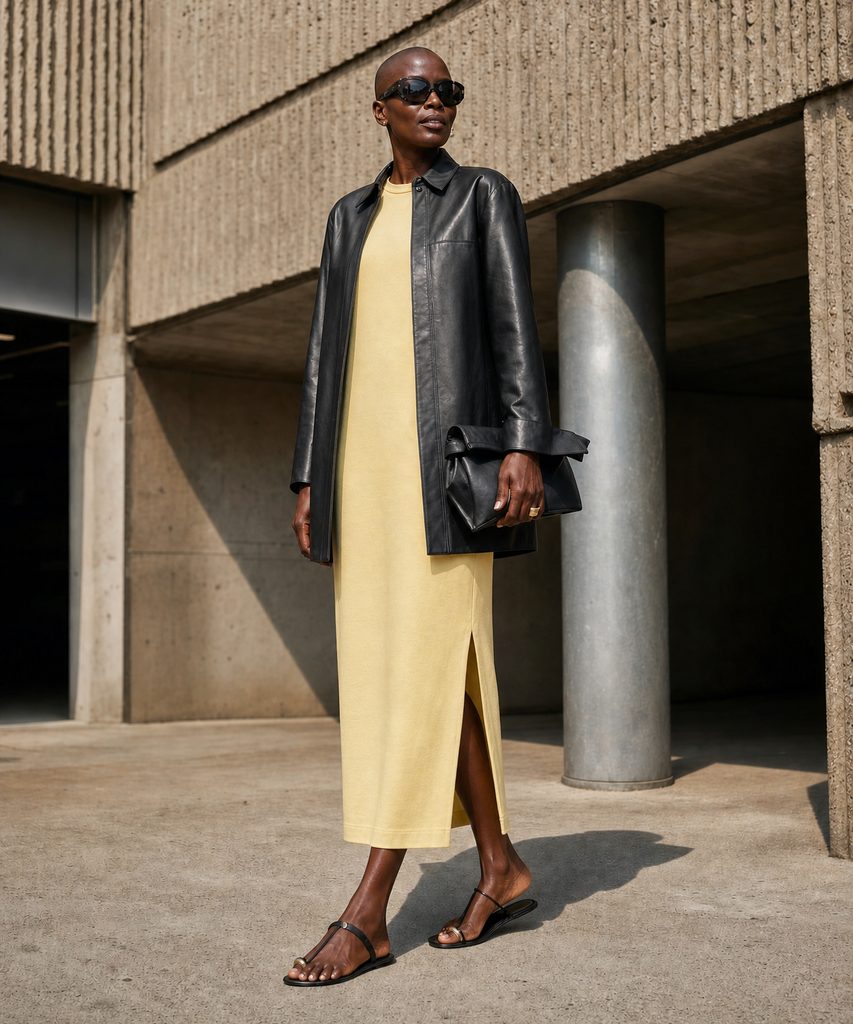
Strategy 2, lean into the line: wear clean, straight or column-shaped pieces that echo your frame, such as slip dresses, shift dresses, straight trousers, boxy tailoring and long coats, and give the outfit a single focal point at the neckline, shoulder, shoe or bag.
The one rule for both: give the eye somewhere to land. An outfit with no definition at all, shapeless on top, straight below and one flat colour throughout, is the only thing that genuinely works against a rectangle.
Rectangle body shape celebrities: outfit analysis
The quickest way to understand both strategies is to see how stylists apply them to well-known straight frames. These six celebrities are frequently described as rectangles. Exact measurements are rarely confirmed, so treat the shape labels as a guide; the styling lessons hold either way.
Zendaya: the column and the sharp shoulder
Zendaya is one of the clearest examples of leaning into the line. Many of her best-known red-carpet looks are long, uninterrupted columns, often in a single colour or metallic, sometimes with a defined or architectural shoulder. On a tall, straight frame the column reads as deliberate and elongating rather than shapeless. When her stylists do add a waist, it tends to be structural, a corseted bodice or a sharp seam, rather than a belt added on top. The lesson: a straight frame is an advantage for column dressing, and when you want curve, build it into the garment.
What to replicate: floor-length slip or column dresses, wide-leg trousers with a matching top, and tailoring with a strong shoulder. Keep the colour unbroken from top to bottom.
Cameron Diaz: the belt and the wrap
Cameron Diaz, with a lean, athletic rectangle frame, has long relied on the opposite strategy for daywear: belted dresses, wrap tops and high-waisted bottoms that mark a waist where there is only a gentle curve. A belt placed at the natural waist instantly gives a straight frame two halves, and a wrap neckline adds a diagonal that suggests curve. The lesson: a belt or a wrap is the fastest way to create a waist on a rectangle, and it works on almost any outfit.
What to replicate: belted shirtdresses, wrap tops and wrap dresses, and a medium-width belt over a straight dress or a long cardigan.
Keira Knightley: the defined bodice and full skirt
Keira Knightley's slender rectangle frame is often dressed in pieces with a fitted bodice and a fuller skirt, from period costume to red-carpet gowns with a nipped seam and a flared or pleated skirt below it. Adding volume at the hip makes the waist above it look narrower by comparison, even when the waist itself has not changed at all. The lesson: you can create a waist from below, not just by cinching it.
What to replicate: full midi skirts, pleated skirts and fit-and-flare dresses with the seam at the natural waist. Tuck the top in so the transition is clean.
Gwyneth Paltrow: minimal tailoring
Gwyneth Paltrow is a long-running example of minimal, tailored dressing on a straight frame: sleek trouser suits, slip dresses, simple shift dresses and clean knitwear in a tight palette of neutrals. None of it relies on waist definition. It works because the fit is precise, the fabric is good and the silhouette echoes the body rather than fighting it. The lesson: on a rectangle, "plain" is not the same as "shapeless" if the cut is sharp.
What to replicate: a well-cut trouser suit, a bias-cut slip dress, a fine-gauge knit with straight trousers. Spend on fit and fabric rather than on detail.
Kendall Jenner: the off-duty column
Kendall Jenner's tall, lean frame is often styled in the off-duty model formula: straight-leg jeans or trousers, a fitted or slightly boxy top, a long coat, and one strong accessory. The outfit is almost entirely vertical lines. The focal point comes from the coat, a pair of sunglasses or a sharp shoe rather than from the waist. The lesson: if you are not creating curve, create a focal point.
What to replicate: straight jeans, a simple tank or baby tee, a long or boxy coat worn open, and one statement accessory. Keep the palette tight.
Taylor Swift: the high waist and crop
Taylor Swift is often described as a rectangle, and one of her most recognisable everyday formulas is a high-waisted skirt or shorts with a cropped or tucked top, so the waistband sits at the natural waist and shows a sliver of the narrowest point. A-line and skater skirts add a little hip volume below it. The lesson: a high rise moves the waistline to where you want it seen, and a cropped or tucked top makes that line visible.
What to replicate: high-waisted A-line skirts, high-rise wide-leg trousers and cropped knits or tucked blouses. Match the top and bottom in contrasting colours if you want the waistline to stand out more.
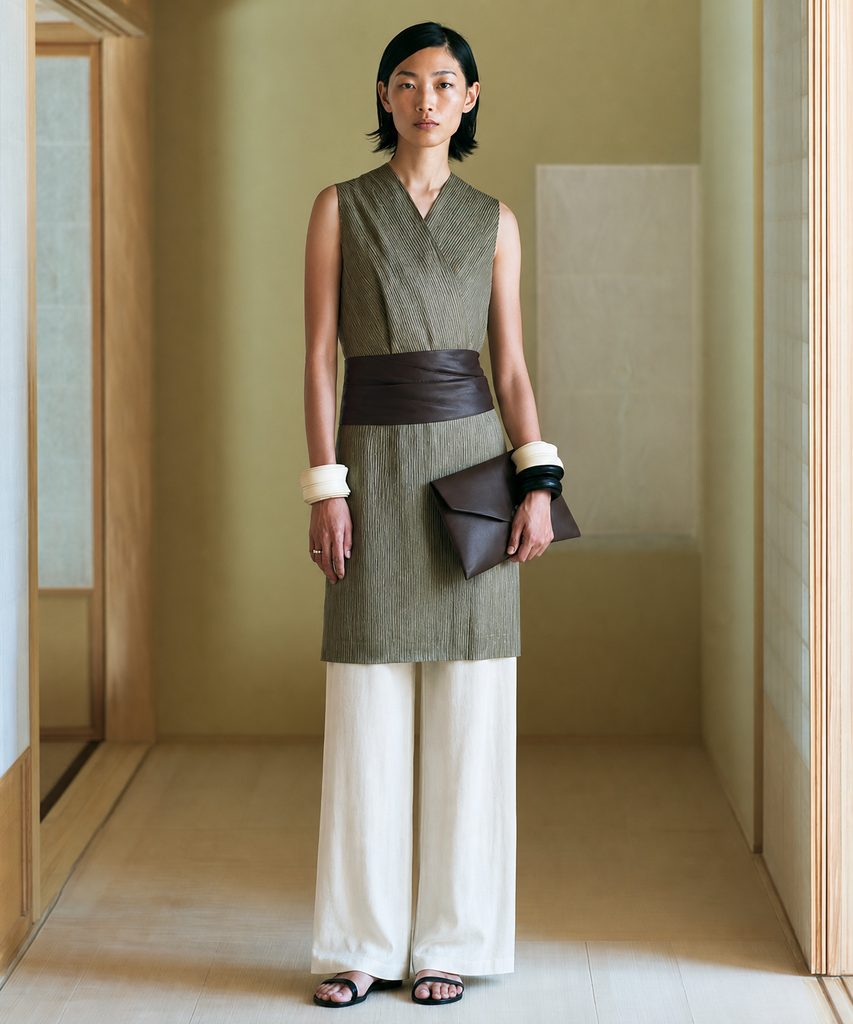
Tops that work for a rectangle figure
Tops for a rectangle either add shape at the bust or define the waist, or both. Here is a category-by-category breakdown:
Peplum tops
A peplum is the single most efficient top for creating curve: it fits through the waist and flares just below it, suggesting a narrower waist and a fuller hip in one garment. Choose a peplum that starts at the natural waist rather than below it, and keep the flare proportionate. Petites should look for a short, soft peplum; taller rectangles can take a longer, more structured one.
Wrap tops and wrap cardigans
A wrap creates a diagonal line across the torso and ties at the waist, which suggests curve even on a very straight frame. Wrap blouses, wrap knits and wrap cardigans all work. A wrap cardigan tied over a tank is one of the easiest everyday ways to add a waist to an otherwise straight outfit.
Ruched, gathered and seamed tops
Ruching at the side, gathering at the waist, a corset-style seam or a tie at the front all draw the fabric in at the narrowest point. These are especially useful in jersey and knitwear, where a belt would bunch.
Tops with detail at the bust
Adding volume or interest at the bust makes the waist look narrower by contrast. Ruffles, chest pockets, a sweetheart or square neckline, a subtle puff sleeve and horizontal stripes across the chest all work. A square neckline is particularly good on a rectangle because it echoes the frame while drawing the eye up.
Plain tops, tucked
If you prefer simple tops, tuck or half-tuck them into high-waisted bottoms. The waistband then does the defining, and a contrast between the top and bottom colour makes the line more visible. A French tuck, just the front, works well with knitwear.
Tops that work against a rectangle figure
- Long, boxy tops worn untucked over straight bottoms: with nothing to break the line, the torso becomes one block from shoulder to hip
- Tops that end at the high hip in the same colour as the bottom: the hem lands at the widest point of the torso without marking the waist
- Very stiff, wide belts over soft knits: the fabric bunches above and below and makes the middle look wider
- Shapeless tunics with no seam, tie or drape: fine as one element, but pair them with a slim bottom and a belt or a strong accessory
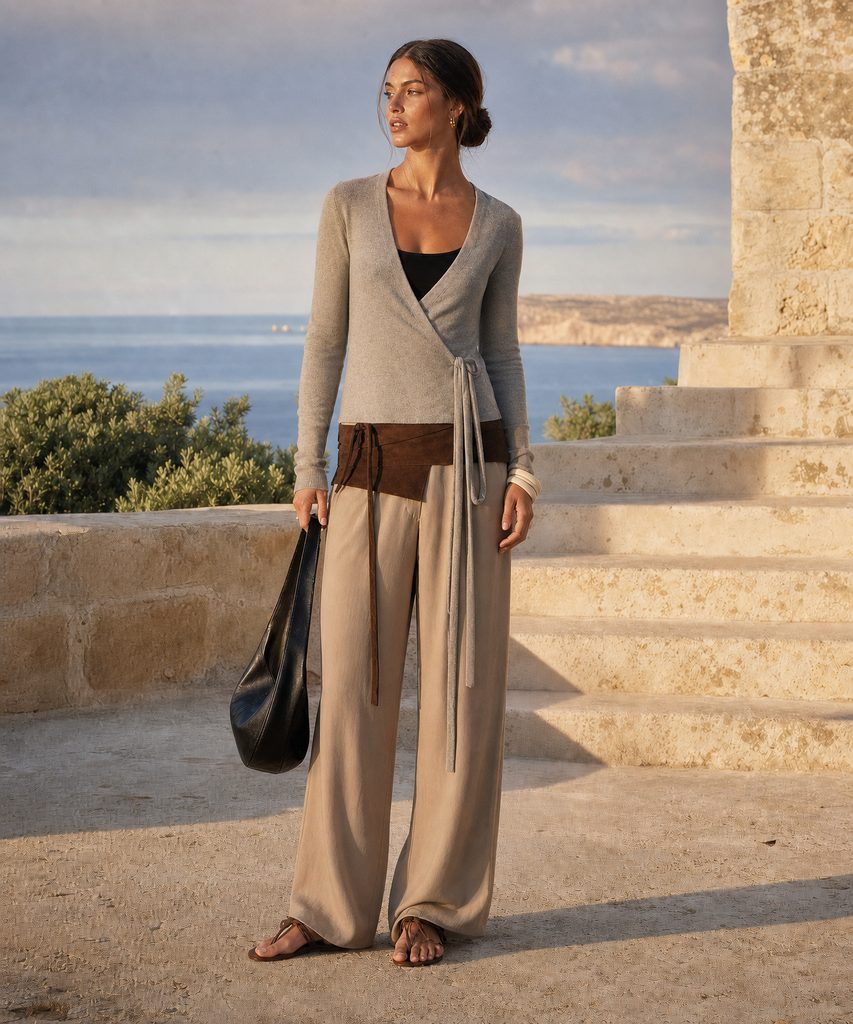
Bottoms that flatter a rectangle figure
Bottoms are where a rectangle can add hip, which makes the waist above look narrower by comparison. The other job of a bottom is to set the waistline, so high rises almost always work better than low ones.
Wide-leg and pleat-front trousers
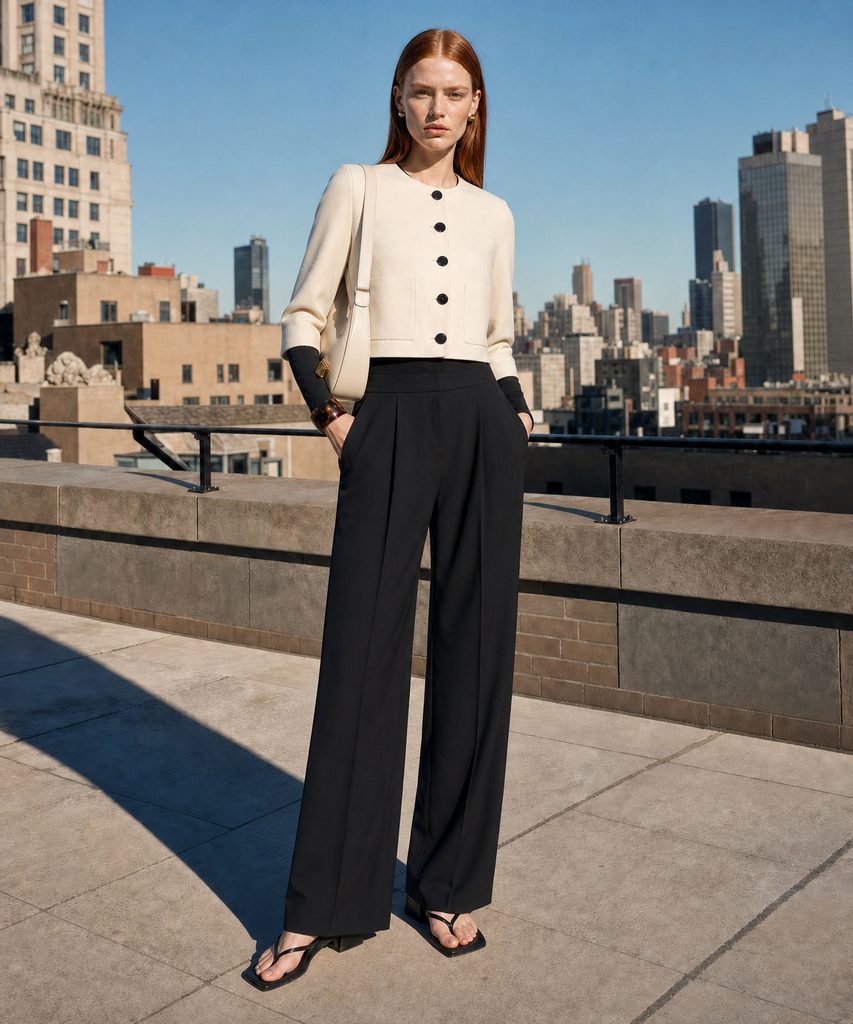
Wide-leg and pleat-front trousers add volume from the hip down, which balances the torso and makes the waist look more defined. In a high rise with a tucked top, they are one of the most reliable rectangle formulas. They also suit the lean-into-the-line strategy when worn with a matching top.
Paperbag-waist trousers
A paperbag waist gathers the fabric at the waistband and ties or belts it, so it creates a waist and adds a little hip volume at once. Keep the top tucked and fairly simple so the waistband stays the focal point.
Full, pleated and A-line skirts
A full or pleated midi skirt is one of the strongest pieces for a rectangle: fitted at the waist, then releasing into volume over the hip. A-line and skater skirts do the same in a shorter length. Pencil skirts also work, but they need the curve to come from the top half, such as a peplum, a wrap or a belted blouse.
Jeans
Choose a high rise in almost any leg shape. Flared, bootcut, barrel and wide-leg jeans add volume below the waist; straight and slim jeans work with a tucked or belted top. Details at the hip, such as flap pockets, yokes and a slightly lighter wash, add curve where you want it.
Bottoms to avoid
- Low-rise bottoms: they drop the waistline to the hip, which is exactly the area that is already straight
- Very flat, straight skirts in a thin fabric with a plain top: fine on their own, but together they leave the outfit without a point of definition
- Elasticated waists with no tie or belt: they sit flat against the waist without marking it
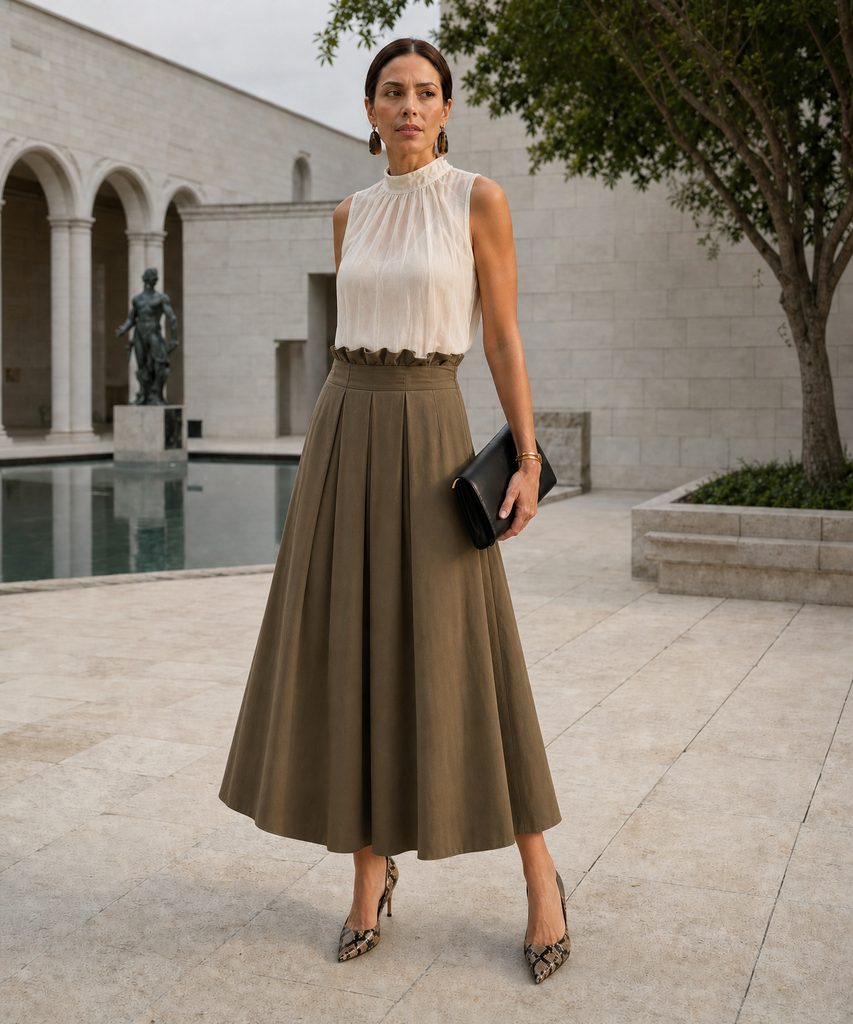
Dresses and jumpsuits for a rectangle figure
Dresses are the category rectangles search for most, and the two strategies work especially clearly here: dresses that manufacture a waist, and dresses that celebrate a straight line.
Wrap dresses
A wrap dress crosses over at the bust and ties at the waist, so it creates both a neckline and a waist in one piece. Choose a fabric with a little weight, such as jersey with body or crepe, so the wrap holds its shape rather than collapsing flat.
Fit-and-flare dresses
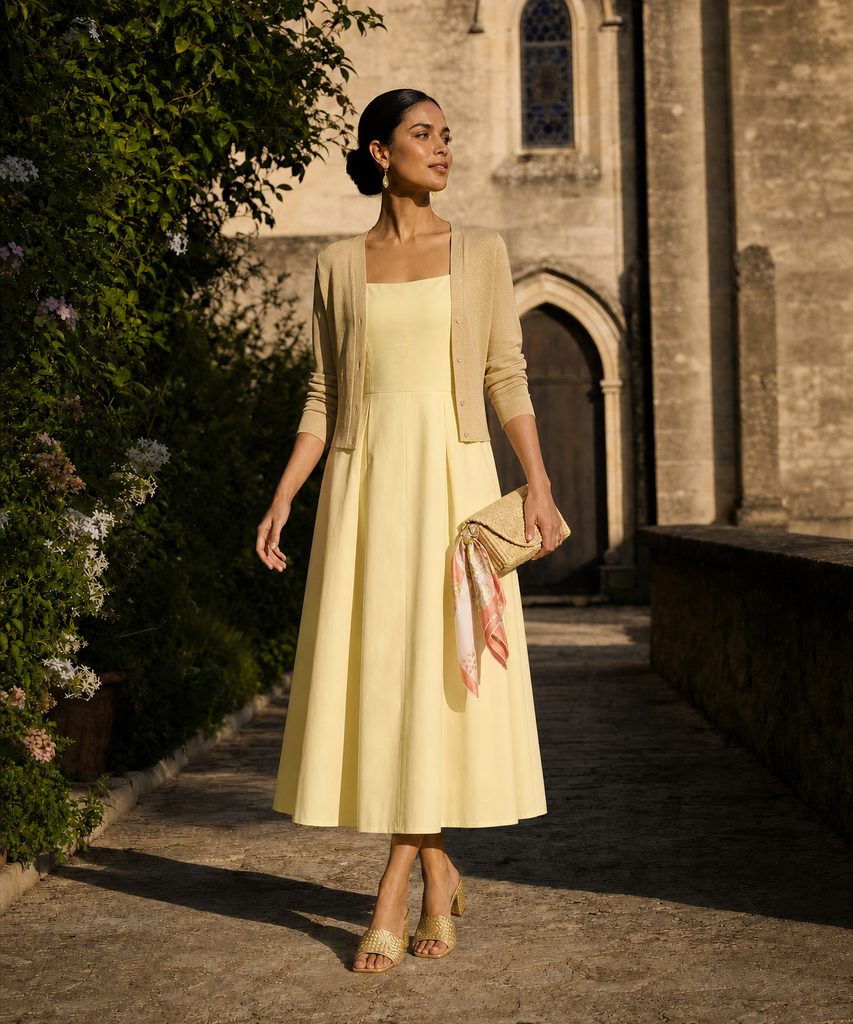
A fitted bodice that releases into a full skirt at the natural waist is one of the most flattering dresses for a rectangle. The flare adds hip volume and the seam marks the waist. A square or sweetheart neckline adds a little curve at the bust as well.
Belted shirtdresses
A shirtdress with a self-tie belt or a separate belt at the waist is a practical everyday option. Without the belt it becomes a lean-into-the-line piece, so one dress gives you both strategies.
Slip, shift and column dresses
If you would rather lean into your line, a straight slip, shift or column dress looks sharp and modern on a rectangle. Bias-cut slip dresses skim the body without needing a waist. Give the outfit a focal point with a strong shoe, a structured bag, an interesting neckline or a jacket over the shoulders.
Dresses with waist detail
Ruching, a cut-out, a corset seam, a contrast panel or a drop of gathered fabric at the waist all create definition without a belt. Side panels in a darker colour are a particularly effective trick, because they visually narrow the middle.
Jumpsuits
Jumpsuits work best with a belt, a drawstring or a wrap top. A wide-leg jumpsuit in one colour also suits the column strategy, especially on a tall frame.
Dresses to approach with caution
- Unbelted, boxy dresses in a stiff fabric: the shape can tent from the shoulder; add a belt or choose a softer fabric
- Drop-waist dresses cut close through the hip: they move the seam to the straightest part of the body; a looser drop waist that releases into a fuller skirt works better
- Bodycon in a thin, shiny fabric: it traces the line without adding any shape; ruched or panelled bodycon works far better
Try these looks on your shape
Stylin shows outfits on your body shape, styled from your own clothes — free on iOS.

Jackets and outerwear
Outerwear is one of the rectangle's strengths. You can choose pieces that cinch, or straight and oversized cuts that echo your frame.
Belted trench and wrap coats
Belted trench coats and wrap coats create a waist with no effort, and they look polished open or closed. Tie the belt at the natural waist rather than leaving it loose at the back.
Blazers
A blazer with a nipped waist, or a single button at the natural waist, adds shape. A double-breasted blazer with a defined waist does the same with more structure. If you prefer a boxy blazer, wear it open over a tucked top so the waistband still shows.
Cropped jackets
A cropped jacket that ends at the waist marks the narrowest point clearly, especially over high-waisted wide-leg trousers or a full skirt. Tweed and boucle jackets, cropped cardigans and short leather jackets all work.
Long, straight and oversized coats
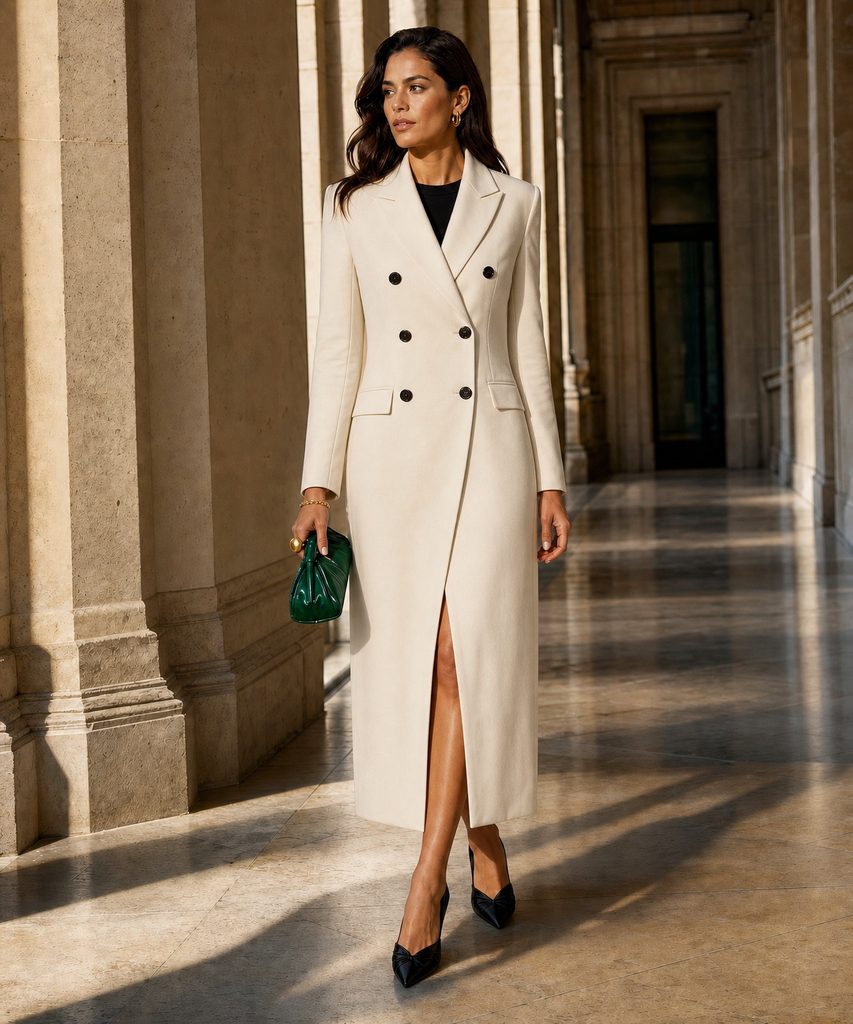
The rectangle is one of the few shapes that suits boxy, oversized and double-breasted coats without adjustment. The straight cut echoes your frame, so it looks deliberate. A long coat worn open over a column outfit creates two long vertical lines, which elongates any height.
Outerwear to avoid
- Puffer jackets with no waist or drawcord, worn over equally bulky layers: choose a belted or cinched puffer instead
- Jackets that end at the high hip in the same colour as the trousers: they hide the waist without creating a line
Fabrics, colour and pattern
Fabric and colour are two of the easiest ways to add dimension to a rectangle without changing the cut of anything.
Fabrics
Fabrics with some body, such as crepe, poplin, linen, denim and wool, hold the shape of a peplum, a pleat or a flared skirt, so they create curve on their own. Soft, fluid fabrics such as silk, satin and fine jersey suit the lean-into-the-line strategy, because they skim a straight frame beautifully. Mixing textures, such as a chunky knit over a satin skirt, adds depth that a single flat fabric lacks.
Colour-blocking
Colour-blocking is a quiet but powerful trick for a rectangle. A darker panel at the sides of a dress, or a dark belt between a light top and a light bottom, visually narrows the waist. A clear contrast between top and bottom marks the waistline. For column outfits, the opposite applies: one colour or one colour family from top to toe creates an unbroken line. Our guide to outfit colour combinations covers pairings that work in both directions.
Pattern
Pattern placement is flexible on a rectangle because the top and bottom halves are already balanced. Diagonal and wrap patterns suggest curve, horizontal stripes at the bust or hip add a little width where you want it, and a bold print on one half with a solid on the other creates a focal point.
Occasion-specific outfit formulas
Here are four complete outfit formulas, two using each strategy, so you can see exactly how the principles turn into real outfits.
Work outfit formula (create curve)
Top: a wrap blouse or a fine knit with a square neckline, tucked in
Bottom: high-waisted, pleat-front wide-leg trousers in navy, charcoal or camel
Outerwear: a blazer with a nipped waist or a single button at the natural waist
Shoes: pointed flats or a block-heel loafer
Accessory: a slim leather belt in a colour that contrasts with the trousers
Why it works: the wrap and the belt create a waist, the pleat-front trousers add volume over the hip, and the nipped blazer repeats the curve when it is buttoned.
Casual / weekend formula (create curve)
Top: a striped Breton or a fitted tee, French-tucked
Bottom: high-rise barrel or wide-leg jeans
Layer: a cropped cardigan or a short denim jacket that ends at the waist
Shoes: trainers or ballet flats
Why it works: the tuck and the cropped layer both mark the waist, and the fuller leg balances the torso.
Evening formula (lean into the line)
Dress: a bias-cut slip or column dress in satin, silk or a metallic
Layer: a sharp-shouldered blazer or a cropped faux-fur jacket over the shoulders
Shoes: a strappy heel or a pointed mule
Focal point: statement earrings or a structured mini bag
Why it works: the column echoes a straight frame and looks long and deliberate, and the jacket and accessories give the eye a clear place to land.
Smart casual formula (lean into the line)
Top: a fine-gauge crew-neck knit or a crisp shirt
Bottom: straight-leg trousers or jeans in the same colour family
Outerwear: a long, straight coat worn open
Shoes: loafers or a sleek ankle boot
Why it works: a tonal outfit under an open coat creates two long vertical lines, which is the most elongating shape a rectangle can wear.
Common mistakes to avoid
Rectangle dressing goes wrong in a small number of predictable ways. Knowing why helps you spot them in the fitting room.
No point of definition anywhere
A shapeless top over straight bottoms in one flat colour gives the eye nowhere to land, so the outfit reads as a block. Add one thing: a belt, a tuck, a contrast colour, a strong shoe or a statement neckline.
Using the wrong belt for the fabric
A wide, stiff belt pulled tight over a soft knit bunches the fabric and makes the middle look wider. Use a thin belt or a tie belt on knitwear, and save wide or obi belts for structured fabrics.
Low rises
Low-rise bottoms set the waistline at the hip, where a rectangle is already straight, so they lose the waist entirely. A mid or high rise is almost always the better choice.
Overdoing volume on a small frame
On a petite rectangle, a very full peplum, a big skirt and a puff sleeve in the same outfit can overwhelm the frame. Pick one source of volume per outfit.
Trying to hide the shape
Treating a straight frame as a problem leads to layering everything and defining nothing. The rectangle suits more silhouettes than most shapes; choose the strategy you like for each outfit rather than hiding.
How Stylin helps rectangle figures
Once Stylin knows your body shape, it filters every outfit and shopping suggestion through that lens, so you see combinations that either build a waist or lean into your line, rather than a generic feed. When it suggests new pieces to fill gaps in your wardrobe, those picks are filtered for your proportions too.
Frequently asked questions
What exactly defines a rectangle body shape?
A rectangle body shape has a bust and hips within about 5% of each other and a waist that is less than 25% narrower than both, so the torso reads as a fairly straight line from shoulder to hip. Shoulders usually line up with the hips. It is also called a straight, banana, H or athletic shape, and it occurs at every size and height.
How do I know if I have a rectangle body shape?
Measure your bust at the fullest point, your natural waist at the narrowest point, and your hips at the fullest point. If your bust and hips are within about 5% of each other and your waist-to-hip ratio (waist divided by hips) lands between roughly 0.80 and 0.90, you have a rectangle shape. If the ratio is below about 0.75, you are closer to an hourglass.
What is the difference between a rectangle and an hourglass?
Both have balanced bust and hips, so the waist is the deciding factor. An hourglass has a waist at least 25% narrower than the bust and hips, a waist-to-hip ratio of roughly 0.70 to 0.75. A rectangle has a waist only about 10 to 20% narrower, a ratio of roughly 0.80 to 0.90. Between 0.75 and 0.80 you sit in the overlap and can borrow from both guides.
Is a banana body shape the same as a rectangle?
Yes. Banana, straight, H, ruler and rectangle are all names for the same proportions: balanced bust and hips with a softly defined waist. Square is sometimes used for the same shape on a broader frame. Athletic usually means a rectangle on a lean or muscular build, unless the shoulders are clearly wider than the hips, in which case it is an inverted triangle.
What is the main styling goal for a rectangle shape?
There are two equally valid goals. The first is to create a waist and a little curve by cinching the middle and adding volume at the bust or hip. The second is to lean into the straight line with clean, column-shaped and tailored pieces. Most rectangles use both, depending on the outfit and the occasion.
What dresses suit a rectangle body shape?
Wrap dresses, fit-and-flare dresses, belted shirtdresses and dresses with a seam, ruching or cut-out at the waist all create a waist. If you prefer to lean into your line, straight shift, slip and column dresses look sharp and modern on a rectangle. Add a belt to a straight dress whenever you want more shape.
What tops are best for a rectangle shape?
Peplum tops are the most efficient piece because they suggest a narrower waist and a fuller hip at once. Wrap tops, tops with ruching or a seam at the waist, and tops with detail at the bust such as ruffles, pockets or a square or sweetheart neckline also add curve. Tuck plain tops into high-waisted bottoms so the waistband does the defining.
What jeans and trousers suit a rectangle?
High-rise styles work best because they set the waistline where you want it seen. Wide-leg, flared, paperbag-waist and pleat-front trousers add volume below the waist, which makes the waist above look narrower. Straight-leg and slim jeans also work, as long as the curve comes from the top half or a belt.
Can a rectangle body shape wear oversized clothes?
Yes, more easily than most shapes. Boxy, oversized and double-breasted pieces echo a straight frame, so they look deliberate rather than shapeless. The one thing to avoid is going oversized from head to toe in one flat colour with no point of definition. Pair an oversized top with a slimmer bottom, or tuck it at the front.
What belts work best on a rectangle?
Medium-width belts worn at the natural waist work on most outfits. Wide, soft obi or sash belts look good over structured fabrics such as linen, poplin and wool. Very wide, stiff belts on soft knits tend to bunch the fabric and make the middle look wider, so swap to a thin belt or a tie belt on knitwear.
How should a petite rectangle dress?
The goal is the same, but scale matters more. Choose narrow belts, modest peplums and a gentle flare rather than full volume, and favour cropped jackets that end at the waist. High-rise bottoms and tonal outfits in one colour family lengthen the frame, and a straight column dress suits a petite rectangle especially well.
How should a plus-size rectangle dress?
A plus-size rectangle carries weight evenly around the torso, with arms and legs in proportion, which is what separates it from an apple. Waist definition works best when it is built into the garment, such as a wrap, a seam, a belted jacket or a tie waist, rather than a wide, tight belt over a soft knit. Structured fabrics and a V or square neckline add shape without bulk.
What swimwear suits a rectangle body shape?
Look for anything that adds definition at the waist or curve at the bust and hip: belted or ruched one-pieces, side cut-outs, high-leg bikini bottoms, and tops with ruffles, a bandeau twist or a push-up shape. Colour-blocked one-pieces with a darker panel at the sides create the illusion of a narrower waist.
Which celebrities have a rectangle body shape?
Celebrities often described as rectangles include Zendaya, Cameron Diaz, Keira Knightley, Gwyneth Paltrow, Kendall Jenner and Taylor Swift. Their stylists use both rectangle strategies: belts, wraps and full skirts to create a waist, and sharp tailoring and column gowns to lean into a long, straight line. Celebrity measurements are rarely confirmed, so treat any list as a guide.
Is the rectangle the most common body shape?
Large sizing studies that sort women by body shape usually find the rectangle to be the most common shape by a wide margin, followed by the pear, inverted triangle and hourglass. Definitions vary between studies, so treat the ranking as a rough guide. Most people are a blend of two neighbouring shapes rather than a textbook example of one.
Knowing your shape is the easy part. The hard part is applying it to a whole wardrobe, every morning, for every occasion. Stylin learns your shape and taste, builds outfits from the clothes you already own, and fills gaps with shopping picks that suit your proportions, all through the app's body-shape outfit feed.