
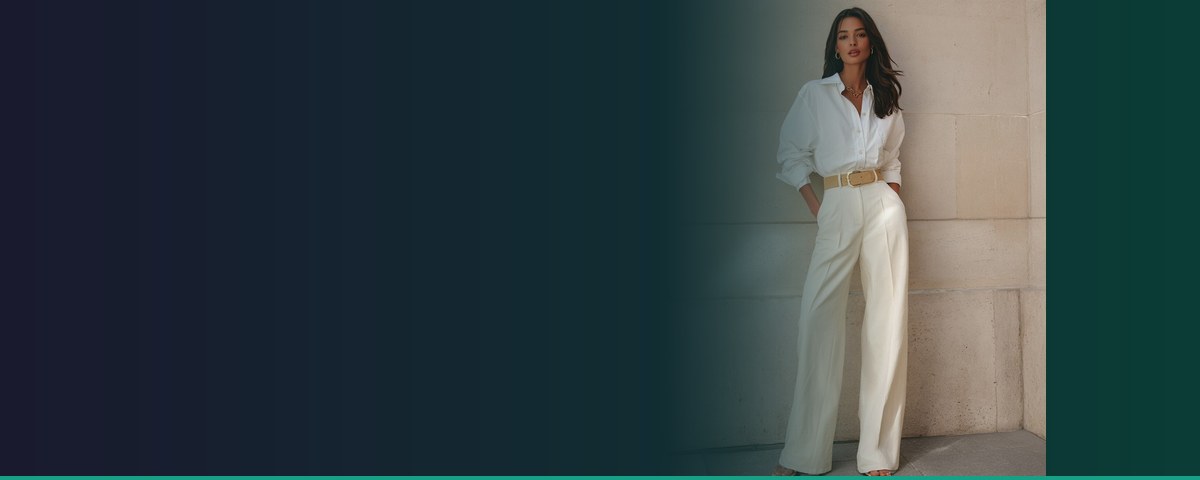
If your shoulders and hips are roughly the same width, and your waist is noticeably narrower than both, you most likely have an hourglass body shape. It's one of the most balanced silhouettes in fashion — which means the styling goal is refreshingly simple: show off your natural proportions instead of hiding them.
This guide goes deep. You'll find a precise definition of the shape, common misconceptions, celebrity outfit breakdowns that explain why specific looks work, and section-by-section recommendations covering every category from tops to outerwear — including what to avoid and why. At the end are four occasion-specific outfit formulas and a detailed FAQ.
Measure your bust, your natural waist, and your hips. You have an hourglass shape if your bust and hips are within about 5% of each other and your waist is at least 25% narrower than both. In practice that usually looks like shoulders and hips of similar width with a clearly visible inward curve at the waist from the front, and a defined waistline from the side.
Size and height are irrelevant to the test — it measures proportion, not circumference. An hourglass at a size 18 and an hourglass at a size 6 have the same relationship between the three numbers.
What exactly defines an hourglass body shape
Stylists and clothing researchers define the hourglass shape using proportional measurements rather than absolute sizes. The three markers are:
- Bust and hips are balanced — within approximately 5% of each other in circumference
- The waist is clearly defined — at least 25% narrower than both the bust and hips
- Weight distributes roughly evenly between the upper and lower body
To measure yourself: take your bust at the fullest point, your natural waist (about an inch above your navel, at the narrowest point), and your hips at the fullest point. If your bust and hips are within about 5 centimetres of each other, and your waist measurement is at least 25% smaller than both — congratulations, you have classic hourglass proportions.
What an hourglass figure looks like at different sizes
Because the definition is proportional, the same shape presents very differently depending on frame and size — which is why so many people rule themselves out incorrectly. A petite hourglass at 5'2" may have a 15-centimetre difference between waist and hips; a tall or plus-size hourglass may have a 30-centimetre difference. Both satisfy the 25% rule, and both are hourglass.
The phrase "extreme hourglass" gets used for figures where the waist is dramatically narrower than the bust and hips — roughly 30% or more, rather than the 25% threshold. It is a description of degree, not a separate body shape, and the styling advice below does not change: the goal is still to follow the waist rather than obscure it. A more pronounced ratio simply means fitted and waist-defining pieces do more of the work on their own, and heavily structured or padded garments become less necessary.
At the other end, a "soft" or gently curved hourglass sits close to the 25% line. Here the waist benefits from a little help — a belt, a wrap, a seam, or a half-tuck — to make the definition read clearly through the garment rather than only on the body.
Common misconceptions about the hourglass shape
The most persistent misconception is that "hourglass" implies a very small waist, very large hips, and a very full bust. That is one version of the shape, but it is not the definition. You can be hourglass at any size and any height. A size 18 woman with balanced hips and bust and a defined waist is just as much an hourglass as a size 6. A petite woman at 5'2" is just as much an hourglass as someone who is 5'10".
The second misconception is that only women with an extreme waist-to-hip ratio qualify. Some hourglass figures are very curvy; others are more gently curved. What matters is the proportion — the relationship between the measurements — not the absolute size of the measurements.
A third common error: confusing "hourglass" with "pear." If your hips are significantly wider than your bust — more than 10% larger — you are closer to a pear or triangle shape. True hourglass requires that the bust and hips are roughly equivalent. If your bust is noticeably larger than your hips, that's closer to an inverted triangle. Balance between top and bottom is the defining feature. If you're not certain which shape applies to you, our guide to how to dress for your body type covers all five shapes with a simple measurement method for identifying yours.
Celebrity examples: outfit analysis
The most practical way to understand why certain cuts and silhouettes work for an hourglass figure is to study how they look on people with well-documented proportions. What follows are six celebrity case studies, each analyzing a specific type of look and why it succeeds anatomically.
Sofia Vergara — the fitted column dress
Sofia Vergara has one of the most discussed hourglass figures in Hollywood, with a bust and hips that are very close in measurement and a markedly defined waist. She frequently appears on red carpets in column dresses — fitted from shoulder to hem with no flare — that demonstrate something counterintuitive: a straight cut on an hourglass body does not look boxy. Because the fabric follows the natural ins and outs of her figure, the dress itself takes on an hourglass silhouette even though the garment cut is technically a straight line. The effect works because the dress is in a draped, stretchy fabric (typically jersey or crepe) that skims each curve rather than pulling at one and gaping at another. The lesson: a fitted column dress in a draping fabric flatters the hourglass by letting the body define the shape.
What to replicate: any fitted midi or maxi dress in jersey or crepe, in a solid colour or simple print, worn with a thin belt if needed at the waist to emphasise that narrowest point. Avoid the same dress in stiff satin or structured brocade — those fabrics will create a tent-like effect rather than following your figure.
Scarlett Johansson — the tailored blazer formula
Scarlett Johansson has proportions that sit closer to the fuller hourglass end — a substantial bust balanced by similarly proportioned hips, with a defined but not dramatically narrow waist. She has spoken about needing tailored pieces because off-the-rack garments tend to fit either the top or the bottom but not both simultaneously. Her go-to formula is a structured, single-button blazer with a defined waist seam, worn over a fitted top with straight-leg or slightly flared trousers. The blazer does the heavy lifting: the shoulder seam lands exactly at her shoulder (not dropped), the single button closures at the natural waist draw attention to that narrowest point, and the lapels create a vertical V shape through the bust area that elongates the upper body. The trouser leg — straight or slightly flared from the hip — balances the width of the hips without adding volume.
What to replicate: a single-button blazer in a medium-weight fabric (wool blend, ponte, or crepe) that has a defined waist seam or can be belted. Avoid double-breasted blazers for this shape — the extra buttons and fabric across the chest adds horizontal emphasis at the widest point. Also avoid boxy, oversized blazers that end at the hip; they obscure the waist and extend the upper body to the same width as the hips, creating a rectangular silhouette.
Beyoncé — high-waisted bottoms and the tucked-in top
Beyoncé represents a fuller, more athletic version of the hourglass — strong shoulders, prominent hips, and a waist that is clearly defined but not dramatically small. Her most consistent styling choice, from red carpets to everyday off-duty looks, is the high-waisted bottom paired with a tucked-in or cropped top. The logic is precise: the waistband of a high-rise trouser or skirt sits at or just above the natural waist, locking in at the narrowest point and anchoring the eye there. The cropped or tucked-in top keeps the torso visually clean and lets the high waist read as the centrepoint of the silhouette. In photographs, this combination creates a visually elongated lower body (the high waist makes the legs look longer) and a balanced, proportional top half.
What to replicate: high-waisted trousers, jeans, or skirts — the higher the better. Pair them with any top that stays tucked in or is naturally short enough to stay above the waistband. Even a simple fitted T-shirt tucked into high-waisted wide-leg trousers recreates the essential architecture of this formula. The one element to avoid: low-rise anything. A low-rise trouser or skirt cuts the silhouette at the hip rather than the waist, visually widening the hip area and losing the defining characteristic of the shape.
Salma Hayek — the wrap dress as a precision instrument
Salma Hayek at petite height (5'2") demonstrates that the hourglass shape works at every stature. Her signature evening look involves wrap dresses or wrap-style bodices, typically in deep jewel tones — wine, emerald, midnight blue. The wrap style works as a near-perfect solution for the hourglass for anatomical reasons: the fabric literally wraps around your waist and ties, so the garment adjusts to your actual waist measurement rather than a standardised cut. This means someone with a dress size that corresponds to their hips or bust can still get a fitted waist without alteration. The V-shaped neckline created by the wrap also elongates the upper body, which is particularly valuable for petite hourglass figures where extra length in the torso is welcome. At 5'2", a wrap dress in a midi length (hitting around the knee) creates the illusion of longer legs while defining the waist.
What to replicate: any wrap dress or wrap-bodice top. Pay attention to the depth of the V — a moderate V is most versatile. For petite hourglass figures specifically, avoid wrap dresses with a very low tie point (at the hip rather than the true waist) because that moves the defining element to the wrong place. The tie should sit at your natural waist, not at the hip.
Marilyn Monroe — the pencil skirt and structured top combination
Marilyn Monroe's styling from the 1950s remains one of the most studied examples of hourglass dressing, precisely because her costumers understood the shape's requirements before the fashion vocabulary for it had been formalised. Her most iconic combinations involved a structured top — often a fitted blouse with princess seaming or a tucked-in shell — paired with a high-waisted pencil skirt. The pencil skirt is architecturally ideal for the hourglass: it follows the hip line downward without flaring out, it sits at the natural waist (when cut correctly), and the knee-length hem creates a full-body silhouette that echoes the top half's proportions. The structured top with princess seaming (vertical seams that run from the shoulder through the bust and down the waist) adds shape to the upper body without adding bulk. The result is a silhouette that emphasises curves at every point where they naturally exist.
What to replicate: a fitted pencil skirt in ponte, wool crepe, or cotton-lycra, sitting at the natural waist, paired with a fitted top or structured blouse that stays tucked in. Modern update: a mock-neck or ribbed fitted top tucked into a pencil skirt achieves the same silhouette with a contemporary feel.
Kim Kardashian — contrast and colour blocking at the waist
Kim Kardashian has popularised a styling technique that works exceptionally well for hourglass figures: using colour contrast to draw the eye directly to the waist. This appears in various forms — a light-coloured top with a dark skirt, a corset or waist-cinching element in a contrasting tone, or a dress with a colour-blocked waist panel. The reason this technique is so effective on an hourglass silhouette specifically is that the waist is already the narrowest part; colour contrast doesn't create the impression of a waist where none exists (as it might for other shapes) — it simply announces and celebrates one that is already there. Fitted latex, structured corsetry, and bodycon fabrics all appear in her wardrobe, demonstrating that the hourglass shape can accommodate very fitted, body-conscious garments when the fit is precise.
What to replicate: colour-blocked midi dresses with a contrast waist panel, two-piece sets where the top and bottom are slightly different tones, or simply a belt in a contrasting colour at the natural waist of a monochromatic outfit. Note the caution: very tight, constricting garments work when the fit is exact but can look strained when they don't fit perfectly. If a bodycon dress is pulling at the hips or gaping at the waist, it is the wrong size regardless of how much you like the style.
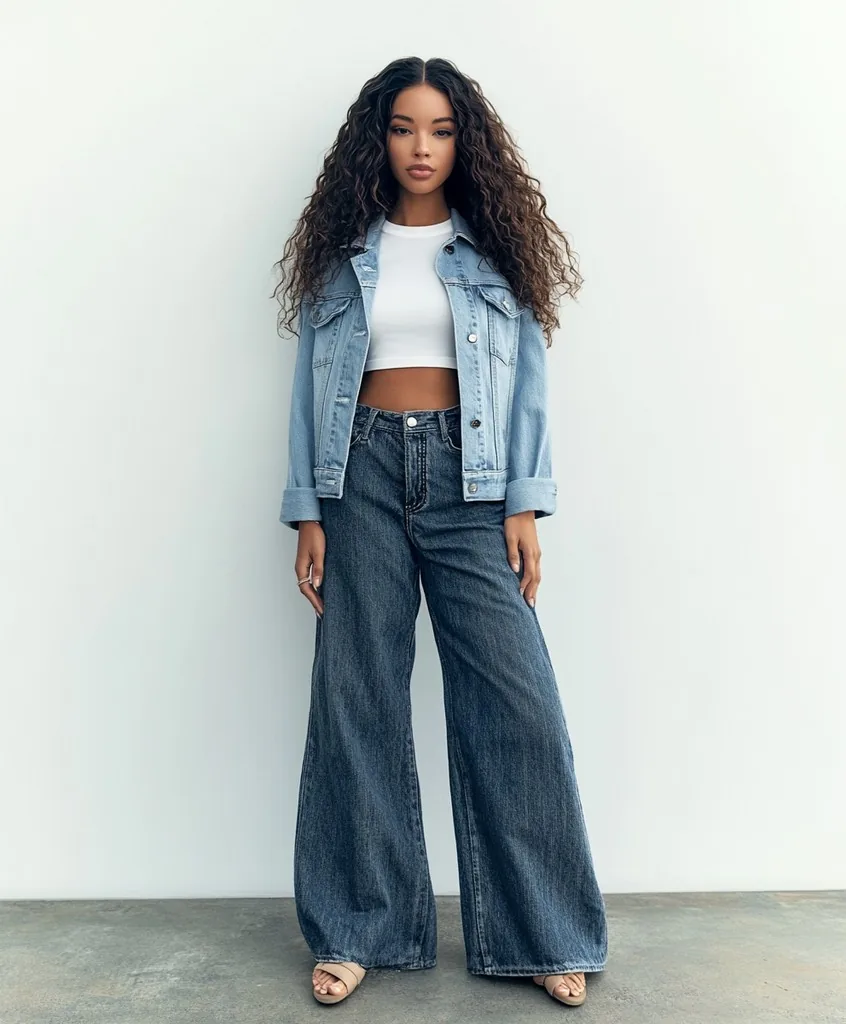
Tops that work for hourglass figures
The fundamental requirement for any top on an hourglass figure is that it should not obscure the waist. Beyond that, the variations are wide. Here is a category-by-category breakdown:
Wrap tops
The wrap top is the most reliable option available. Like the wrap dress, the fabric ties at your actual waist measurement, accommodating the difference between your bust and waist without tailoring. The V-neckline that results from the wrap is flattering at almost any bust size. For a fuller bust, choose a wrap with a V that is moderate in depth — not too plunging, which can become impractical, but deep enough to create a clean elongating line. Wear wrap tops with high-waisted trousers or skirts; the point where the top meets the bottom should be at or very close to your natural waist.
V-necks and scoop necks
Any neckline that creates a downward-pointing V or U shape elongates the upper body and creates a visual vertical line through the bust. For a larger bust, a V-neck reduces the visual heaviness of the chest by breaking it into two sections. Scoop necks work similarly, though they are slightly less elongating. These necklines are effective in fitted and semi-fitted tops alike. What to avoid: very wide V-necks that go beyond the edge of your bust, which can look accidentally undone rather than deliberate.
Peplum tops
A peplum top has a flared section that begins at the waist. This sounds counterintuitive for an hourglass — won't it add volume at the hips? — but a well-cut peplum actually does the opposite: it defines the waist sharply at the point where the flare begins, and the small added volume at the hip is usually minimal enough to be flattering rather than overwhelming. The key is that the peplum should begin exactly at your natural waist and the flare should be modest (not a full ruffle). A tailored peplum in a structured fabric — ponte, thick crepe, scuba — works well. A very large, ruffled, or droopy peplum adds volume where the figure is already widest and should be avoided.
Fitted ribbed tops and bodysuits
Ribbed tops in a medium-weight cotton-lycra blend are some of the most practical items in an hourglass wardrobe. The rib texture adds subtle visual interest without adding bulk; the stretch accommodates the difference between the bust and the waist; and the fitted cut allows the body's natural shape to show. Ribbed bodysuits (with a snap or hook closure at the crotch) are even more streamlined because they stay tucked in regardless of movement. This makes them ideal under high-waisted bottoms. Colour: ribbed tops tend to work best in solid colours rather than prints, as the texture provides enough visual interest on its own.
Tops that work against an hourglass figure
- Boxy, square-cut tops — these hide the waist entirely and make the upper body appear as wide as the hips, creating a rectangular silhouette
- Extremely cropped tops that sit above the natural waist — these can work when paired with a high waist, but if the crop hits at the widest part of the ribcage, it visually broadens the upper body
- Tops with heavy horizontal embellishment across the chest — sequins, embroidery, or large prints that run horizontally at chest level add visual width at an already full area
- Halter necks with very wide straps that create a T-shape through the shoulders — these can look boxy; a thinner strap or a halter with a V-front is more flattering
- Extremely voluminous sleeves with a fitted bodice — bishop sleeves or extreme balloon sleeves add significant width to the upper body; if you love the look, keep the sleeve volume modest and the bodice very fitted
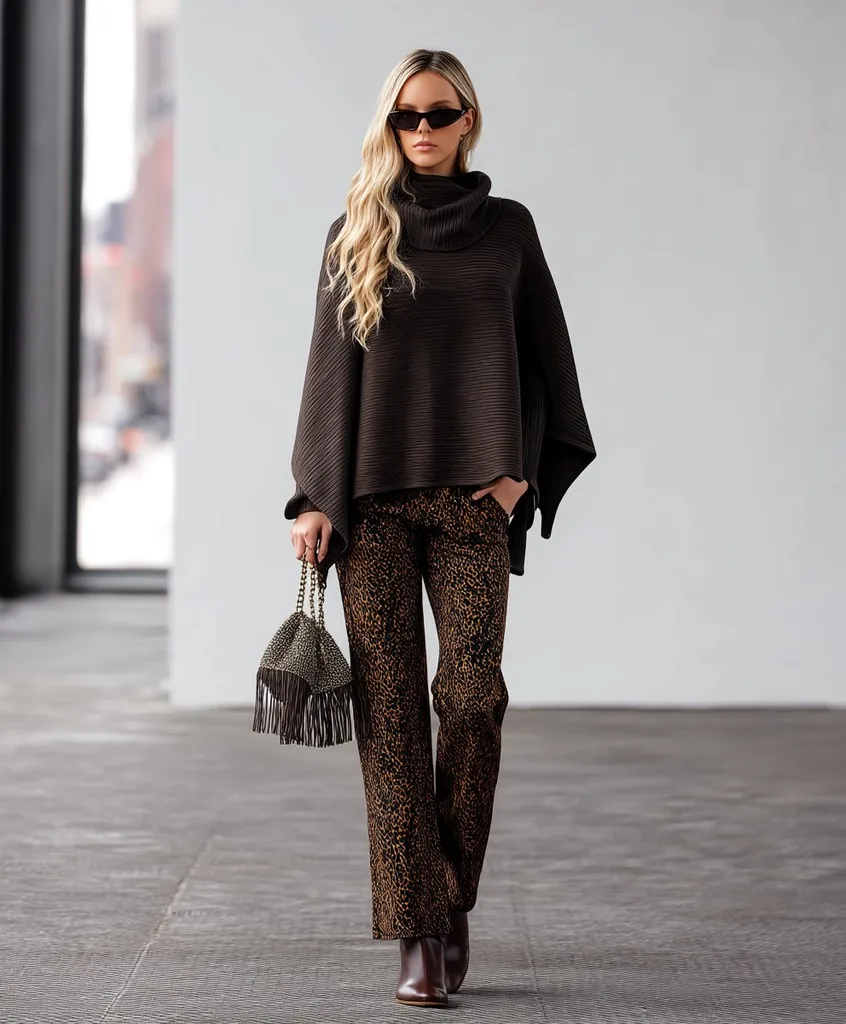
Bottoms that flatter an hourglass figure
The unifying principle for all bottoms on an hourglass figure is simple: the waistband should sit at or very close to the natural waist. This one decision — high-rise rather than low-rise or mid-rise — does more for your silhouette than any other bottom choice.
High-waisted trousers
High-waisted trousers are one of the most versatile and consistently flattering choices for an hourglass body. The high waistband anchors at the narrowest point of your torso, making the visual "centrepoint" of your look read as your waist rather than your hip. From there, you have options for the leg:
- Wide-leg: creates a long, clean column from hip to floor. Wear with a fitted top and flat shoes or low heels to maintain the elongating effect. Very high-waisted wide-legs in a fluid fabric (crepe, linen, viscose) are particularly elegant.
- Straight-leg: classic and practical. Sits close to the thigh without being tight, then falls straight from the knee. Works in denim, twill, and tailoring fabrics. The most universally applicable option.
- Bootcut: the flare from the knee offsets the width of the hips in proportion and creates an elongated leg line. Works particularly well for pear-adjacent hourglass figures where the hips are slightly more prominent.
- Flared (full flare): a dramatic 1970s silhouette that emphasises the contrast between the waist and hips. Best in a fluid fabric that moves; avoid stiff flares that add structural bulk.
High-waisted jeans
High-waisted jeans in a medium to heavy weight denim are a reliable daily workhorse for the hourglass figure. Look for: a waistband that actually reaches your natural waist (many "high-waisted" jeans in the market sit at mid-rise — measure from crotch seam to top of waistband; true high-rise is 11 inches or more); some stretch in the fabric, as a rigid denim will not follow the waist-to-hip curve without alteration; and a fit through the hip and thigh that skims rather than pulls. Avoid "mom jean" styles that are cut very full through the hip and thigh — the excess volume there adds bulk to an already substantial area.
Skirts
- Pencil skirts: the classic choice. Follows your line from waist to knee without adding volume. Works in ponte, crepe, denim, and wool blend. The waistband must sit at the natural waist for the silhouette to work correctly.
- A-line skirts: work well when the A is gentle — slightly flared from the hip rather than full and circular. A very full A-line (sometimes called a circle skirt) adds significant volume at the hem and can make the hip area appear larger than it is. A subtle A-line reads as feminine and balanced.
- Midi and maxi skirts: any length works; what matters is the cut at the waist and hip. A fitted midi in jersey or a maxi wrap skirt are both excellent options.
- Mini skirts: high-waisted mini skirts in a fitted cut show off the leg while keeping the waist defined. Avoid micro-minis in stiff fabrics that sit away from the body.
Bottoms to avoid
- Low-rise anything — cuts the silhouette at the hip rather than the waist, creating visual width where you don't want it and losing the defining characteristic of your shape
- Drop-waist skirts — the seam that should be at the waist falls to the hip, cutting across the fullest part of your lower body
- Unstructured, elasticated waistbands with no definition — these can sit at an unflattering point and add volume around the middle without anchoring at the waist
- Very full gathered skirts with a thick waistband — the volume draws attention to the hips and the wide waistband adds bulk at the waist
Dresses and jumpsuits for an hourglass figure
Dresses are where hourglass dressing is most forgiving, because a well-designed dress can define the waist, follow the hip line, and create a complete silhouette in one garment.
Wrap dresses
The wrap dress was arguably designed with the hourglass figure in mind. The reason it works so consistently is structural: by tying at your actual waist, the dress adjusts to your individual proportions. Standard sizing assumes a fixed relationship between bust, waist, and hip — which works fine for many shapes but often means hourglass women find a dress that fits the bust or the hips but not the waist. The wrap solves this by removing that constraint. The resulting neckline is a V that elongates the upper body. The skirt section — typically A-line or gently flared — follows the hip downward without clinging. In a fluid jersey or silk-like fabric, a wrap dress creates one of the most universally flattering silhouettes available.
For occasions: wrap dresses work across a wide range of settings. A jersey wrap dress is smart casual. A silk or satin wrap dress in a deep colour is appropriate for evening or semi-formal events. A cotton or linen wrap dress is summer-ready. The format is truly versatile.
Bodycon dresses
Bodycon dresses (body-conscious, with significant stretch and a close fit throughout) work well for hourglass figures when two conditions are met: the fabric skims rather than constricts, and the fit is truly accurate. The best fabric for bodycon on an hourglass figure is jersey or ponte with good recovery — meaning it stretches to follow your curves but springs back so there are no areas of visible strain. A bodycon dress in a fabric that is too thin or has insufficient stretch will show every curve in sharp relief, which may not be the intention; one in a thicker, more structured jersey gives a smooth, polished look. Avoid bodycon in fabrics with no stretch at all — structured satin, thick brocade — as these will not accommodate the waist-to-hip ratio and will either gape at the waist or pull at the hips.
Fit-and-flare dresses
Fit-and-flare is the other classic for hourglass figures. The bodice fits closely through the bust and waist, then the skirt flares out from the hip. This directly echoes the natural shape of the hourglass silhouette: fitted on top, defined at the waist, and allowing the hips to read as the widest point without adding excess volume. For maximum effect, the flare should begin exactly at the widest point of the hip — not above it (creating a short bodice and too much flare) and not below it (which can look like a drop-waist). An A-line cut that begins at the natural waist rather than the hip works similarly and slightly elongates the figure.
Jumpsuits
Jumpsuits present more challenges for hourglass figures than dresses, because the crotch-to-shoulder measurement is fixed in a one-piece garment and rarely accounts for the hourglass's significant waist-to-hip ratio. However, they are not off the table. The best hourglass-compatible jumpsuits feature: a wide belt or sash that defines the waist; a wrap-style bodice that adjusts at the waist; or significant stretch throughout. If you find a jumpsuit with these features, it can be an excellent option. If a jumpsuit has a fixed waistband without these adjustments, it will almost certainly need alteration.
Dresses and silhouettes to approach with caution
- Drop-waist dresses — the waist seam falls below your actual waist, typically at the hip, cutting across the widest part of your lower body
- Empire-waist dresses with a fitted bust and full skirt — the seam sits just below the bust, which means the skirt volume falls from a point above your waist, making the lower body appear larger
- Shift dresses — the straight, A-line, slightly boxy silhouette of a shift hides the waist by design. You can sometimes rescue a shift dress with a belt at the natural waist, but the silhouette works against your strengths
- Very full ball-gown skirts — the extreme volume at the hem creates a heavy, unbalanced lower half that overwhelms your natural proportions
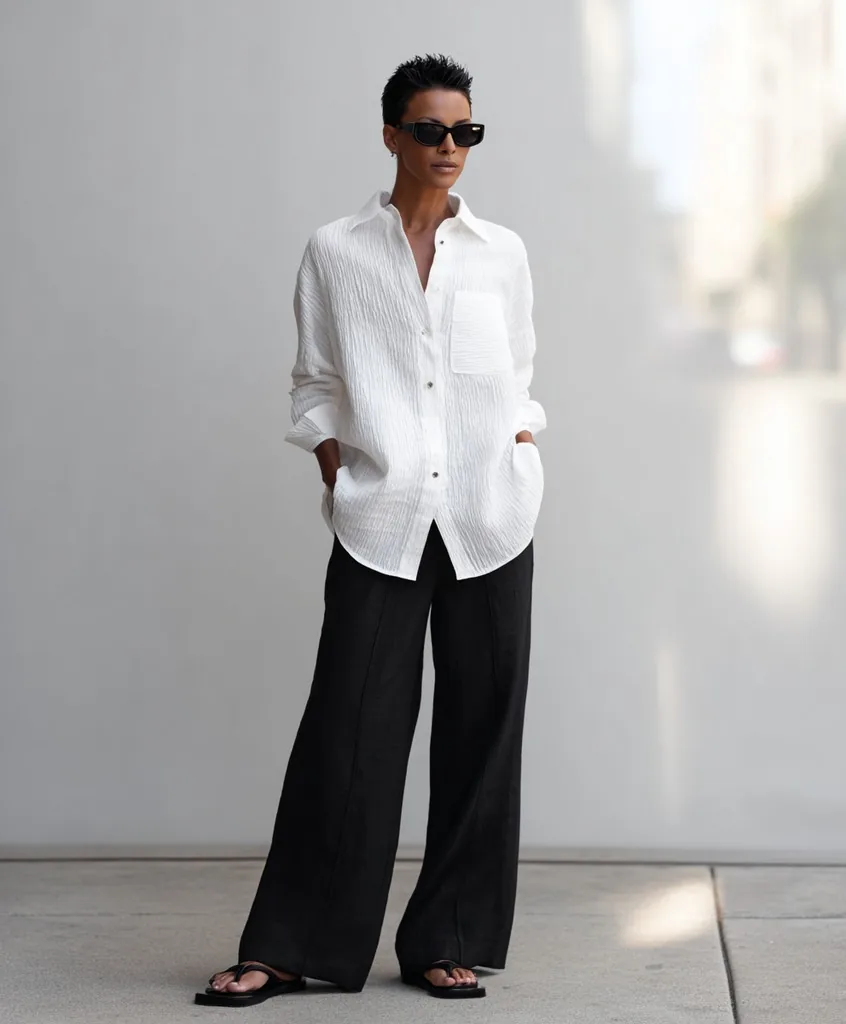
Style your hourglass shape
Stylin builds outfits from your wardrobe shown on your body shape — free on the App Store.

Jackets and outerwear
Outerwear is where the hourglass figure is most commonly undermined. Because jackets and coats are designed to go over other garments, they are often cut with more ease (extra room) than fitted pieces — and that ease can easily swamp an hourglass figure's defining characteristic. The rule here is the same as everywhere else: define the waist.
Belted coats and trench coats
A belted coat or a classic trench coat is one of the best outerwear investments for an hourglass figure. The belt does exactly what it needs to do: it marks the narrowest part of the body even through a thick layer of fabric. The trench coat in particular is cut to allow this — the waist is typically slightly fitted even without the belt, and the belt exaggerates that definition further. In a camel or neutral shade, a belted trench worn over any combination of fitted separates creates one of the most elegant and polished looks available for this shape. Look for: a belt that sits at the natural waist (not the hip), a fit through the shoulders that is precise (not dropped or bunchy), and a length that hits at the mid-thigh or longer — shorter jackets that end at the hip can emphasise width there.
Structured blazers with a fitted waist
A single-button blazer with either a defined waist seam or sufficient structure to be belted is the tailored counterpart to the trench. The key is that the blazer should nip in at the waist rather than cutting a straight line from shoulder to hem. Look for: one or two button closures (the button should sit at or close to the natural waist), structured shoulders that sit exactly at the edge of your shoulder (not dropped), and a length that falls at or just below the hip. Blazers cut from wool blend, ponte, or thick crepe hold their shape without being rigid.
Outerwear to avoid
- Boxy, oversized coats with no belt or waist definition — these hide the figure completely and make the upper body appear as wide as it is long
- Double-breasted coats or blazers — the extra button rows add horizontal lines and visual weight across the chest and abdomen; if you love the style, choose a double-breasted piece that is nipped in strongly at the waist
- Puffer jackets — heavily padded, quilted puffers add significant volume in all directions; if you need one for warmth, look for a fitted puffer that is slimmer through the torso, or a long belted down coat rather than a short puffy jacket
- Hip-length boxy bombers — the typical bomber jacket sits at the hip and is cut straight from shoulder to hem, creating a visual box around the upper body; some fitted bombers in leather or ponte are an exception
Fabrics: what drapes well vs. what adds bulk
Fabric choice matters more than most people realise. The same silhouette in two different fabrics can look entirely different on an hourglass body. The fundamental principle: you want fabrics that follow your shape, not ones that stand away from it.
Fabrics that work well
- Jersey — the most practical and forgiving option. A medium-weight jersey with good recovery (stretches and returns to shape) follows the body's curves smoothly without clinging. Good for dresses, tops, and skirts.
- Ponte — a thicker, denser version of jersey with more structure. Holds its shape without being stiff. Excellent for fitted trousers, pencil skirts, and blazers that need to maintain structure while accommodating curves.
- Silk and silk-like fabrics (viscose, modal) — fluid and light, these drape directly over the body and emphasise curves in the most elegant way. Best for dresses and tops; less practical for fitted trousers.
- Crepe — slightly textured and fluid with good drape. The texture provides enough visual interest without adding bulk. Works well in dresses, tops, and full-length trousers.
- Lightweight knits — ribbed or fine-gauge knitwear follows the body's contours. Goes from fitted and body-conscious (fine-gauge fitted ribbed) to slightly relaxed (chunky loose knit worn with a belt) depending on weight and gauge.
- Denim with stretch — 1–2% elastane in denim allows it to follow the waist-to-hip ratio of an hourglass figure without gaping at the back waistband, which is a common problem with rigid denim.
Fabrics to approach with caution
- Stiff canvas or heavy tweed — these fabrics have significant structure and hold a shape of their own, which means they sit away from the body. A canvas blazer will be rectangular; your curves won't show through it. Reserve these for garments where you want structure, like a blazer that you'll wear with a visible waist somewhere in the outfit.
- Heavily padded or quilted fabrics — add volume in all directions, useful for warmth but not for silhouette
- Very stiff satin — can create a tent-like effect rather than following the body; look for satin-backed crepe or softer satin weaves instead
- Thick neoprene or scuba — very structured and adds some bulk; works in tailored pieces but should be fitted precisely
- Heavily textured boucle or thick cable knit — these fabrics add significant visual and physical volume; they can work in small quantities (a fitted boucle blazer) but a boucle coat or oversized cable-knit sweater will add bulk to the torso
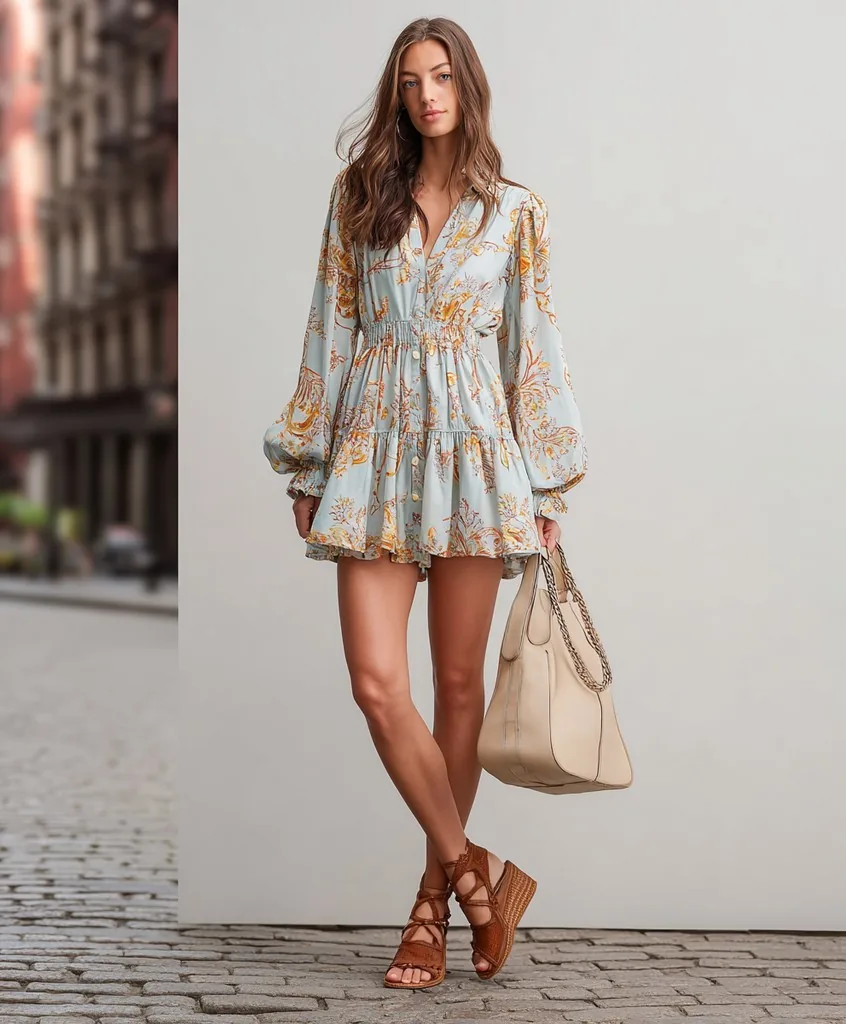
Occasion-specific outfit formulas
Theory is only useful when it translates into specific outfits. Here are four complete formulas — each a concrete prescription rather than a vague guideline.
Work outfit formula
Top: fitted V-neck shell top or structured button-down (tucked in) in a neutral — ivory, camel, navy, or pale grey
Bottom: high-waisted tailored trousers in a ponte or wool blend — straight or slightly wide leg
Outerwear: single-button blazer in the same or complementary neutral, worn open or closed at the waist
Shoes: block-heel ankle boots, pointed-toe kitten heels, or loafers (flats work well because the high-waisted trouser already creates leg length)
One statement: a structured leather tote or a simple gold belt that emphasises the waist
Why it works: the high waist anchors the look at the narrowest point; the blazer adds structure without obscuring the waist if worn open; the pointed shoe creates a clean vertical line to the floor.
Casual / weekend formula
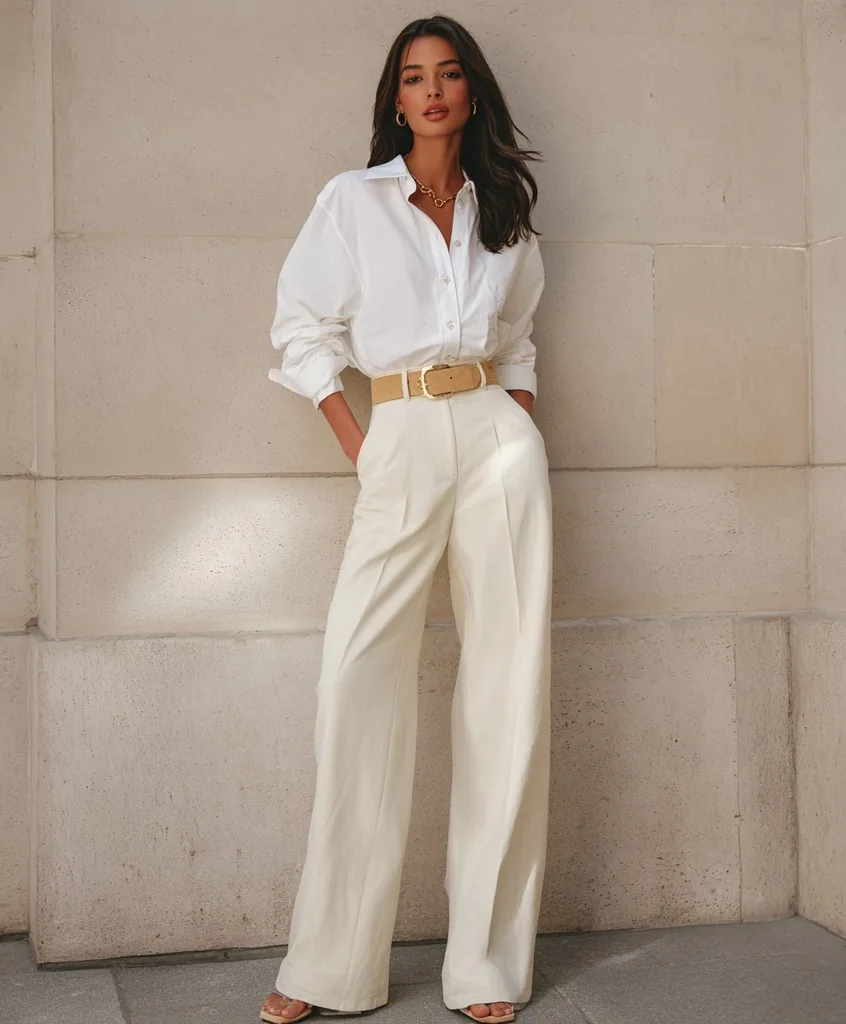
Top: fitted ribbed long-sleeve or a plain fitted tee in a soft neutral — white, cream, sage, dusty pink
Bottom: high-waisted straight-leg jeans with at least 1% stretch, or high-waisted wide-leg linen trousers in summer
Layer: denim jacket (worn open) or a relaxed overshirt that you don't button but leave open as a layer
Shoes: white trainers, flat mules, or loafers
One statement: a crossbody bag or a simple chain-link necklace that draws the eye to the upper body
Why it works: the fitted top tucked into high-waisted jeans maintains the waist definition even in the most casual register. The open overshirt or denim jacket adds informality without closing off the silhouette.
Evening formula
Option A (dress): wrap dress or fit-and-flare dress in a fluid fabric — silk, crepe, or jersey — in a deep jewel tone or rich neutral. Mid-length or floor length.
Option B (separates): high-waisted wide-leg trousers in a luxe fabric (satin, crepe, or velvet) + a fitted off-shoulder or V-neck top
Shoes: heeled sandals or block-heel pumps — the added height is optional, but elongates the leg if desired
One statement: a simple clutch or small bag in a complementary tone. Avoid very large bags in evening settings — they disrupt the clean silhouette.
Why it works: in evening settings, the fluid fabric of a wrap dress or well-cut separates reflects light elegantly while following the figure. Jewel tones flatter the dressed-up mood while remaining timeless.
Smart casual formula
Top: fitted knit turtleneck or mock-neck top (ribbed, medium weight) in a neutral or muted colour
Bottom: high-waisted midi skirt in a solid or subtle print — A-line or fitted pencil in ponte or crepe
Layer: belted trench coat or structured single-button blazer
Shoes: ankle boots (block or slim heel) or pointed-toe flats
One statement: a simple pendant necklace worn over the turtleneck to draw the eye upward, or a quality leather belt in the same tone as the shoes
Why it works: the fitted knit provides warmth and coverage while maintaining the fitted upper-body silhouette; the high-waisted midi skirt defines the waist and creates an elegant, occasion-appropriate length; the belted layer maintains the waist definition even when wearing outerwear.
Common mistakes to avoid
Even with the best intentions, hourglass dressing regularly goes wrong in a predictable set of ways. Understanding why these mistakes work against the shape helps you spot and avoid them in the fitting room.
Loose and baggy everything
The most common mistake is choosing oversized, loose-fitting clothing throughout the entire outfit — loose top, loose trousers, loose jacket — in an attempt to be comfortable or to minimise the appearance of curves. The result is the opposite of what an hourglass figure does naturally: instead of creating a defined silhouette, the outfit creates a rectangular or undefined shape that makes it impossible to read the figure's proportions at all. If comfort is the goal, oversized pieces can absolutely work — but they need to be balanced by something fitted or belted somewhere in the outfit.
Oversized at the shoulders
A garment with very dropped shoulders — where the shoulder seam falls several inches down the arm rather than sitting at the natural shoulder point — creates a rectangular, boxy upper body. Because the hourglass figure depends on the visual balance between the shoulder/bust area and the hip area, losing definition at the shoulder makes the whole silhouette collapse. Shoulders seams should sit at or very close to the edge of your actual shoulder. If you love oversized silhouettes, look for pieces that are oversized through the body but have the shoulder seam in the correct position.
Horizontal stripes at the widest points
Horizontal stripes placed directly across the bust or across the fullest part of the hip add visual width at points that are already substantial. A striped top where the stripes run at chest level, or a striped skirt where the stripes hit at the widest hip point, emphasises width you typically don't want to increase. Horizontal stripes can work elsewhere — across the waist, for instance, can actually emphasise its narrowness — but placement matters enormously.
Very low-rise bottoms
Low-rise trousers and skirts cut the silhouette at the hip, which is the widest point of the lower body. This has the visual effect of widening the apparent hip measurement while shortening the legs. The opposite — a high-rise that cuts at the narrowest point — does the opposite: it narrows the visual width and lengthens the legs. This is possibly the single highest-impact adjustment available in hourglass dressing.
Ignoring the fit-to-proportion problem
Standard garment sizing assumes a relationship between bust, waist, and hip that doesn't match hourglass proportions. Most brands size for a 12-inch waist-to-hip difference; many hourglass figures have a 13–15 inch or larger difference. This means you will regularly buy in your hip or bust size and find the waist gaping, or buy in your waist size and find the hips don't close. The solutions: buy in your hip size and have waists taken in by a tailor (inexpensive for trousers and skirts); buy wrap styles and belted styles wherever possible; and accept that tailoring is part of the process for perfectly fitted clothing at your proportions.
How Stylin helps hourglass figures
Once Stylin identifies your body shape, it filters every outfit and shopping suggestion it makes through that lens — so you're not browsing a generic selection of recommendations but a curated set of combinations where the waist is defined, the proportions are balanced, and the cut is appropriate for your figure. When new items are suggested to fill gaps in your wardrobe, those recommendations are pre-filtered to your shape as well.
Frequently asked questions
What exactly defines an hourglass body shape?
An hourglass shape is defined by three measurements: bust and hips within about 5% of each other in circumference, and a waist that is at least 25% narrower than both. You do not need to be any particular size or height — hourglass proportions occur at every size, from petite to plus-size.
How do I know if I have an hourglass body shape?
Take three measurements — bust at the fullest point, natural waist at the narrowest point, and hips at the fullest point. If the bust and hips are within roughly 5% of each other and the waist is at least 25% smaller than both, you have hourglass proportions. If your hips are more than about 10% larger than your bust you are closer to a pear; if your bust or shoulders dominate, closer to an inverted triangle.
What size is an hourglass figure?
Any size. The definition is a ratio between three measurements, not a dress size or a weight — which means hourglass proportions occur from petite through plus-size. What changes with size is the absolute difference between the numbers, not whether the shape qualifies.
What necklines suit an hourglass body shape?
V-necks, scoop necks, and sweetheart necklines flatter most hourglass figures by elongating the upper body and drawing the eye upward. For a fuller bust, a V-neck creates a clean vertical line. Very high or boxy crew necklines can visually shorten the upper body and hide waist definition.
Can an hourglass body shape wear oversized clothing?
Yes — oversized pieces work well when you reintroduce the waist with a belt, a half-tuck, or a fitted layer underneath. For example, an oversized blazer belted at the waist over a bodysuit keeps the silhouette intentional rather than shapeless.
What's the best dress style for an hourglass figure?
A wrap dress is the classic answer: it defines the waist naturally as you tie it, follows your curves without clinging, and accommodates the fact that your hips and bust are similar in width. Fit-and-flare dresses are a close second, and bodycon works well in jersey or ponte fabrics that skim rather than constrict.
What should a plus-size hourglass figure look for?
The same principles apply at every size: define the waist, balance the proportions, and choose fabrics that skim rather than cling or add volume. High-waisted bottoms, wrap styles, and belted outerwear all work. The key difference at a larger size is fabric — lean toward medium-weight jersey, ponte, or silk that drape cleanly over curves rather than stiff or heavily textured fabrics that add visual bulk.
What if my hips are noticeably bigger than my bust — am I still hourglass?
If your hips are more than about 5–10% larger than your bust, you are closer to a pear or triangle shape rather than a true hourglass. The defining feature of hourglass is the balance between shoulders/bust and hips. If your hips dominate, the styling goal shifts slightly toward adding visual width at the shoulders and keeping detail away from the hips.
Can hourglass women wear wide-leg trousers?
Yes — high-waisted wide-leg trousers are one of the best options for an hourglass shape. The high waist anchors the look at your narrowest point, while the wide leg creates a long, clean line from hip to floor. Pair with a fitted or tucked-in top to maintain the waist definition.
Are horizontal stripes a problem for hourglass figures?
Horizontal stripes placed at the widest point — across the bust or hips — add visual width you typically do not need. However, a horizontal stripe at the waistband or across the midsection can highlight your waist definition. The key is placement, not stripes as a category.
What fabrics work best for hourglass body shapes?
Fabrics that drape — jersey, silk, crepe, ponte, viscose, and lightweight knits — work best because they follow your shape without adding bulk. Stiff fabrics like thick canvas, structured tweed, and heavily padded materials sit away from the body and can obscure your curves. A medium-weight fabric with a small amount of stretch is often the most practical choice.
How should a petite hourglass dress?
The hourglass principles hold — define the waist, keep the balance between bust and hip — but every proportion needs shortening to match your frame. Look for waist seams that actually land on your natural waist rather than an inch below it, jacket hems that stop above the widest part of your hip, and three-quarter sleeves that don't swallow your hands. Keep the number of horizontal breaks low: a top, a bottom and a shoe line read as three sections, and adding a belt, a jacket hem and a cuff on top of that chops a shorter frame into fragments. Vertical continuity in colour does most of the heavy lifting.
What swimwear works for an hourglass body shape?
Anything that supports the bust properly and marks the waist. Underwired or structured tops matter more here than the cut of the leg — an unsupported bust drops the whole line and the balance the shape depends on goes with it. Belted or ruched one-pieces, wrap fronts, and high-waisted two-pieces all define the middle and keep the top and bottom halves reading as equals. Halter necks work well; bandeaus tend not to unless they're genuinely structured. What to skip: boyshort bottoms, which cut across the fullest part of the hip and square off a curve that doesn't need squaring.
Knowing your shape is the straightforward part — the challenge is consistently applying it across an entire wardrobe and across every occasion, mood, and budget. Stylin learns your shape and taste, then builds outfits from what you already own and fills gaps with shopping picks calibrated to fit your proportions — all surfaced through the app's body-shape outfit feed.