
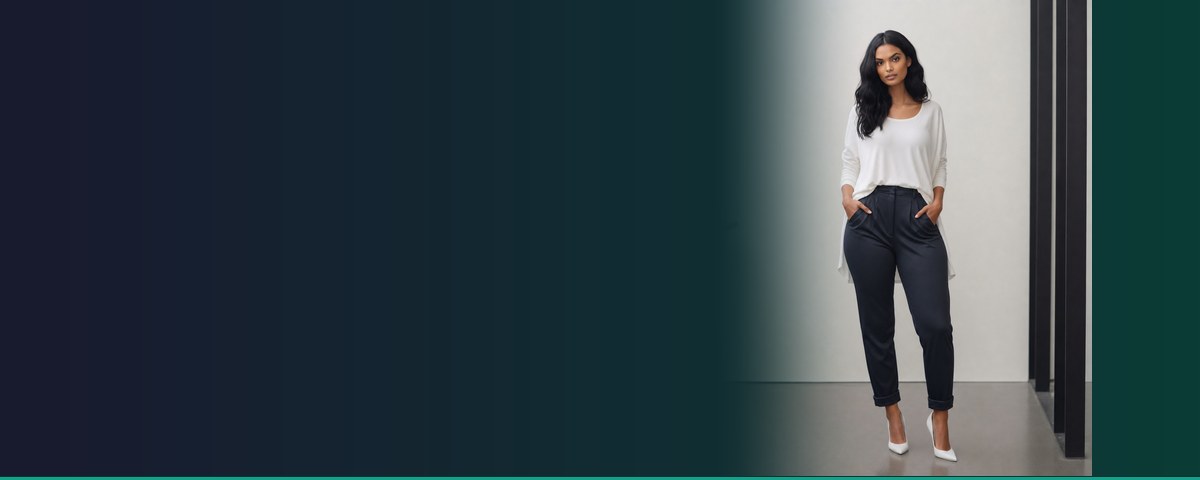
If your hips and thighs are the widest part of your body, your shoulders and bust are comparatively narrow, and you have a defined waist, you most likely have a pear body shape — sometimes called a triangle. It's one of the most common female silhouettes, and the styling goal is clear and achievable: balance the proportions by drawing the eye upward, so your figure reads as even from top to bottom.
This guide goes deep. You'll find a precise definition of the shape, common misconceptions, celebrity outfit breakdowns that explain why specific looks work, and section-by-section recommendations covering every category from tops to outerwear — including what to avoid and why. At the end are four occasion-specific outfit formulas and a detailed FAQ.
Measure your bust, your natural waist, and your hips. You have a pear (triangle) shape if your hips are more than about 5% larger than your bust and your waist is clearly narrower than your hips. From the front that usually reads as shoulders narrower than the hipline, with the widest point falling at the hip or upper thigh rather than the waist or bust.
The quickest way to separate pear from hourglass: an hourglass has a bust and hips that are roughly equal, while a pear has hips that clearly dominate a narrower upper body. Both have a defined waist, so the waist alone will not tell you which you are.
What exactly defines a pear body shape
Stylists and clothing researchers define the pear shape using proportional measurements rather than absolute sizes. The three markers are:
- Hips are the widest point — noticeably larger than the bust and shoulders, typically by more than 5% in circumference
- The waist is defined — narrower than the hips, giving a clear curve into the lower body
- Weight settles below the waist — on the hips, thighs, and bottom, while the upper body stays comparatively slim
To measure yourself: take your bust at the fullest point, your natural waist (about an inch above your navel, at the narrowest point), and your hips at the fullest point. If your hips are more than about 5% larger than your bust, and your waist is clearly narrower than your hips, you have a pear (triangle) shape. The defining feature is that the lower body carries more visual weight than the upper body.
What a pear shape looks like at different sizes
Because the definition is proportional, the pear shape presents differently across frames and sizes while remaining the same shape. A petite pear may carry a 10-centimetre difference between bust and hips; a taller or plus-size pear may carry 25 centimetres or more. Both are pears, and both take the same styling approach — the difference is one of degree, not of category.
A "gentle" pear sits just past the 5% threshold: the hips lead, but only slightly. Here the balancing work is light — a boat neck, a lighter colour on top, or a little shoulder structure is usually enough to even the silhouette, and heavy statement shoulders can tip the proportions too far the other way.
A more pronounced pear, where the hips are 15% or more larger than the bust, benefits from doing that same work more deliberately: stronger shoulder lines, more contrast between top and bottom, and bottoms cut to skim rather than cling. The principle does not change with the ratio — only how much of it you need.
Common misconceptions about the pear shape
The most persistent misconception is that a pear shape is something to disguise or minimise. It isn't. The pear silhouette includes a naturally defined waist — one of the most sought-after features in fashion — and the styling approach is about balance, not concealment. The aim is to bring the upper and lower body into visual harmony, not to hide the hips.
The second misconception is that pears must always wear dark, shapeless clothing on the bottom. Dark, matte bottoms are a useful tool, but they are not a uniform. A pear figure can wear colour, pattern, and fitted styles on the lower body — the key is to balance them with equal or greater interest on top.
A third common error: confusing pear with hourglass. Both have a defined waist, but an hourglass has a bust and hips that are roughly equal, while a pear has hips that clearly dominate the upper body. If your shoulders and bust are noticeably narrower than your hips, you are a pear; if they are balanced, you are an hourglass. This distinction changes the styling goal entirely — the hourglass simply emphasises the existing balance, while the pear works to create it. If you're still deciding which of the five shapes fits you best, our overview of how to dress for your body type walks through every shape in one place.
Celebrity examples: outfit analysis
The most practical way to understand why certain cuts and silhouettes work for a pear figure is to study how they look on people with well-documented proportions. What follows are six celebrity case studies, each analyzing a specific type of look and why it succeeds anatomically.
Beyoncé — the statement shoulder
Beyoncé, who carries strong curves through the hips and thighs with a defined waist, frequently builds looks around a structured or embellished shoulder. Whether it's a sharply tailored blazer with a defined shoulder line, a one-shoulder gown with detail at the neckline, or a top with a dramatic sleeve, the strategy is consistent: add visual width and interest at the top of the body so the eye registers the shoulders as broad as the hips. The effect balances the silhouette into an hourglass read. The lesson: anything that emphasises the shoulder — structure, embellishment, volume, or a horizontal line — pulls the proportions into balance for a pear figure.
What to replicate: blazers with structured shoulders, tops with detail or volume at the shoulder and sleeve, and necklines that run wide across the collarbone. Keep these paired with a clean, darker bottom so the upper-body interest does the work.
Jennifer Lopez — the bootcut and the clean column
Jennifer Lopez has built decades of red-carpet looks around a simple principle for her curvier lower half: create one long, uninterrupted line from waist to floor. Her go-to is a high-waisted bootcut or flared trouser in a matte fabric, often monochromatic with a fitted top in the same tone. The slight flare from the knee balances the width of the hip — the leg widens gently lower down, which makes the hip look proportional rather than dominant — and the single colour from shoulder to shoe elongates the whole figure. The lesson: a bootcut or flare offsets the hip, and a monochromatic column removes the horizontal break that would otherwise draw the eye to the widest point.
What to replicate: high-waisted bootcut or wide-leg trousers in a dark or matte solid, worn with a tucked-in fitted top, ideally in a related tone. Add a heel if you want extra length. Avoid breaking the line with a contrasting belt or a top that ends right at the hip.
Kim Kardashian — the fit-and-flare and the defined waist
Kim Kardashian, who carries pronounced hips, often uses the fit-and-flare silhouette and waist-cinching to her advantage. A bodice that fits the torso closely and flares gently from the waist defines the narrowest point and then skims over the hip rather than clinging to it. By marking the waist sharply — with a seam, a belt, or a corseted bodice — the eye is directed to the waist as the focal point, and the flared skirt section glides past the hips without emphasising their width. The lesson: define the waist clearly, then let the fabric float away from the hip rather than tracing it.
What to replicate: fit-and-flare dresses, A-line skirts that begin at the natural waist, and any silhouette that cinches the waist and releases over the hip. Choose fabrics with enough body to hold the flare away from the thigh.
Shakira — the off-shoulder and Bardot neckline
Shakira frequently wears off-shoulder and Bardot (wide boat-neck) tops, and the reason they work for a pear figure is anatomical: a neckline that runs horizontally across the collarbones, exposing the shoulders, makes the upper body read as wider. That added perceived width at the top balances a fuller hip. The exposed shoulder line is itself a focal point that draws the eye up and away from the lower body. The lesson: horizontal necklines and bared shoulders are a pear's friend — they are precisely the detail that broader-shouldered shapes are told to avoid, which is why generic advice often steers pears wrong.
What to replicate: off-shoulder tops, Bardot necklines, boat necks, and square necks. Pair them with simple, darker bottoms so the neckline remains the focal point.
Catherine, Princess of Wales — the tailored coat-dress
Catherine, Princess of Wales, favours tailored coat-dresses and structured shift-with-waist-definition pieces that demonstrate how a pear figure reads as elegant and balanced through precise tailoring. Her coat-dresses typically have a defined shoulder, a nipped waist, and a skirt section that skims to the knee without clinging — a silhouette that adds structure up top, marks the waist, and floats over the hip. The fabrics are matte and substantial enough to hold their shape. The lesson: structured tailoring that builds the shoulder and defines the waist creates balance without any need to hide the lower body.
What to replicate: a structured coat-dress or a fitted dress with a defined shoulder and waist, in a matte, medium-weight fabric. Keep the hemline at or just below the knee in a clean A-line or gently tailored cut.
Rihanna — colour and print placed at the top
Rihanna uses colour and print strategically, frequently placing the boldest element of an outfit on the upper body — a patterned or bright top, a statement jacket, an eye-catching neckline — over a darker, simpler bottom. The principle is straightforward: the eye goes first to the brightest, busiest, or most textured part of an outfit. By placing that at the top, the gaze settles on the shoulders and face, balancing a fuller hip that's dressed in quieter tones. The lesson: let colour, pattern, and texture live on the top half, and keep the bottom half restrained.
What to replicate: bright or printed tops, jackets, and scarves over dark trousers or skirts. When you do want pattern on the bottom, keep it small-scale and dark, and balance it with something equally strong on top.
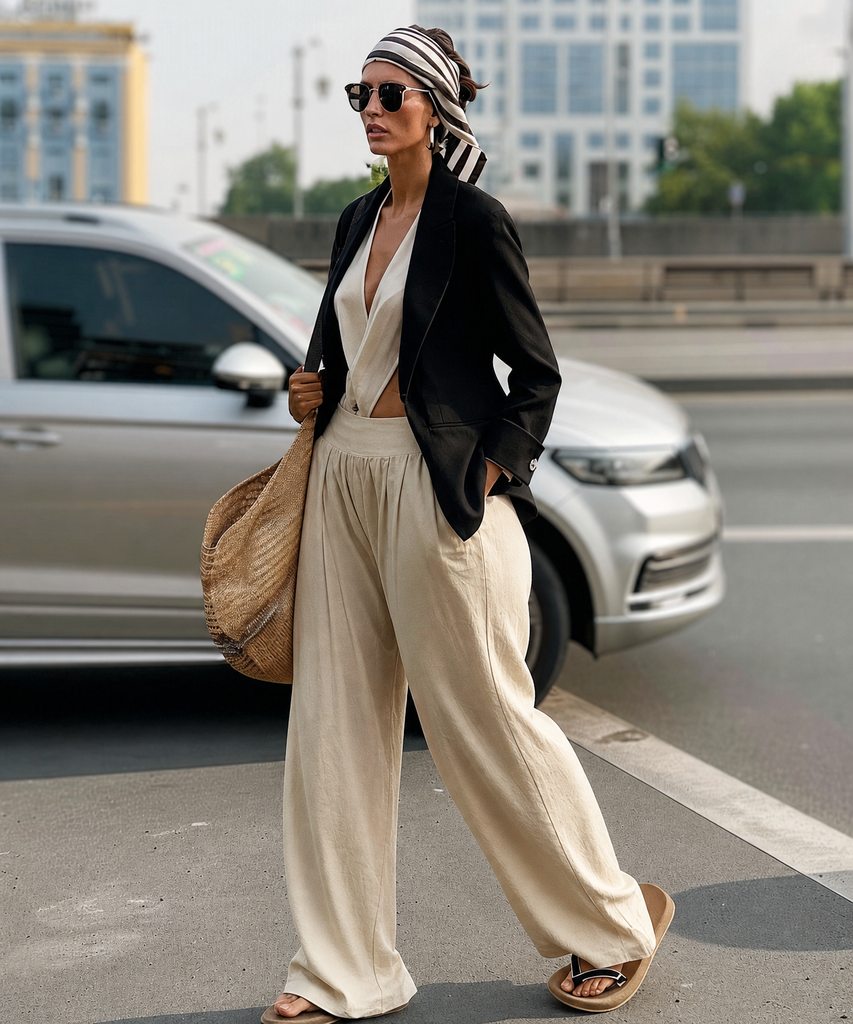
Tops that work for pear figures
For a pear figure, the top half is where you build visual interest and width. The fundamental requirement is that a top should draw the eye up and broaden the shoulder line. Here is a category-by-category breakdown:
Boat necks and Bardot tops
A boat neck runs horizontally across the collarbones, and a Bardot top sits off the shoulders entirely. Both add perceived width to the upper body and draw the eye up to the face — exactly what balances a fuller hip. These are among the most reliable necklines for a pear figure. Wear them with high-waisted bottoms so the waist stays defined. The one caution: if your bust is very full, a true off-shoulder may need a supportive build, so look for styles with structure or a discreet inner band.
Structured and detailed shoulders
Anything that builds the shoulder — a tailored seam, a subtle pad, a puff sleeve, an epaulette, or embellishment — widens the top of the silhouette and brings it into proportion with the hip. Puff and statement sleeves are particularly effective and on-trend. Keep the volume at the shoulder and upper arm rather than letting it drop to the elbow or hip level.
Bright and printed tops
Colour, pattern, and texture all attract the eye, so placing them on the top half pulls the gaze upward. A bright top, a bold print, or a textured knit over a plain dark bottom is a simple, repeatable formula for balancing a pear figure. This is the inverse of the bottom-half advice: keep your lower body quiet and let the top do the talking.
Peplum and waist-defining tops
A peplum top defines the waist sharply and then flares slightly, skimming over the hip rather than clinging to it. For a pear figure this works well because it marks the waist — your strong feature — while gliding past the hip. Choose a peplum that ends at the high hip rather than the widest point, and keep the flare structured rather than droopy. Wrap tops achieve a similar waist-defining effect.
Tops that work against a pear figure
- Tight, plain, dark fitted tops worn alone — a narrow, quiet top leaves the lower body as the only point of interest, which emphasises the hip
- Tops that end exactly at the widest part of the hip — a hem landing on the fullest point draws a horizontal line precisely where you want to minimise width
- Raglan and dropped shoulders — these narrow and soften the shoulder line, the opposite of what balances a pear; choose set-in or structured shoulders instead
- Deep, narrow V-necks with no shoulder detail — these can make narrow shoulders look even narrower; a wider scoop or boat neck is more balancing
- Spaghetti straps with no structure — very thin straps minimise the shoulder; a wider strap or a detailed neckline adds the width you want up top
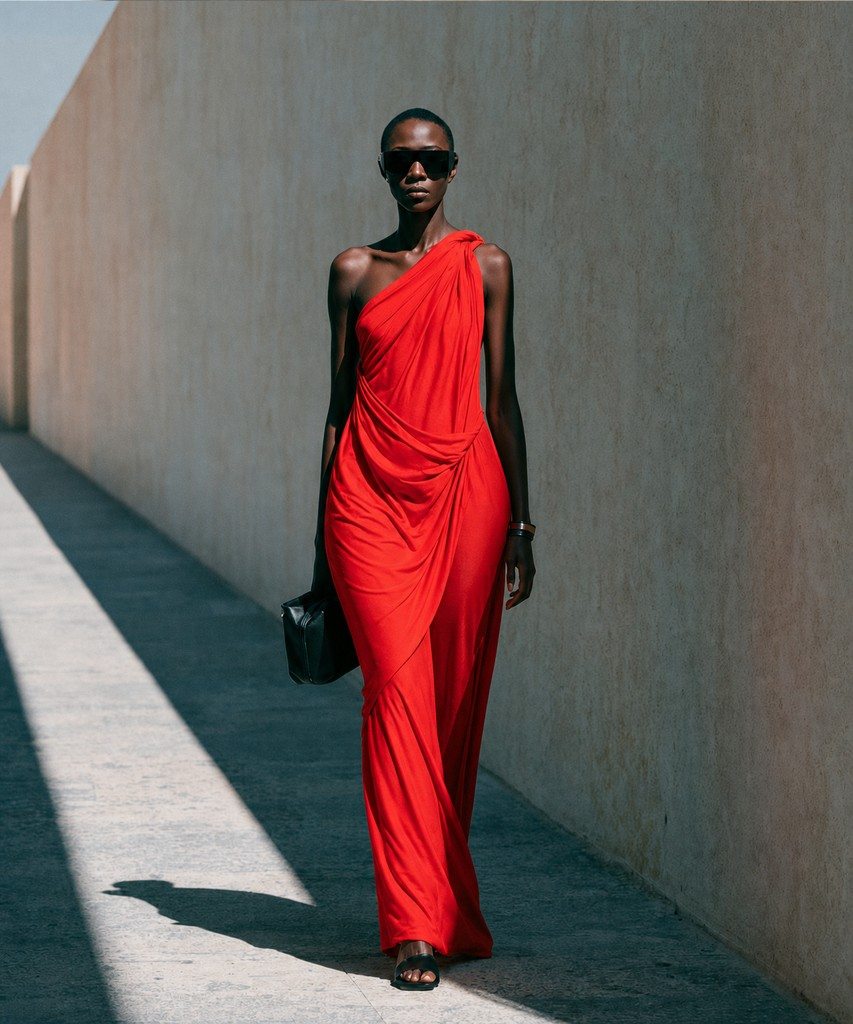
Bottoms that flatter a pear figure
The unifying principle for all bottoms on a pear figure is simple: skim the hip and thigh rather than cling to them, and create a long, clean line to the floor. Matte, darker fabrics and cuts that gently widen the leg lower down both serve this goal.
Straight-leg and bootcut trousers
Straight-leg trousers fall cleanly from the hip without tapering, which avoids the "ice-cream-cone" effect of a wide hip narrowing to a thin ankle. Bootcut trousers go one step further — the slight flare from the knee balances the hip by adding a touch of width lower down, evening out the proportions. Both work best high-waisted, in a matte fabric, and in a dark or mid tone. They are the most reliable trouser shapes for a pear figure.
Wide-leg trousers
High-waisted wide-leg trousers create one long column from the waist to the floor, skimming over the hip and thigh entirely. In a fluid, matte fabric — crepe, wool blend, or heavier viscose — they are elegant and balancing. Pair them with a fitted or tucked-in top to keep the waist defined, and choose a length that reaches the floor for the longest possible line.
Dark, matte jeans
For denim, choose a dark wash with no fading, whiskering, or distressing across the hip and thigh — those light patches act like a spotlight on the widest point. A straight or bootcut leg is most balancing, though a dark, matte skinny jean works well when paired with a top that adds volume up top. Look for some stretch so the denim follows the waist-to-hip curve without gaping at the back.
Skirts
- A-line skirts: the ideal skirt for a pear figure. The skirt widens gently from the waist, skimming over the hip and creating a balanced triangle that mirrors and softens the body's own line. Best in a fabric with enough body to hold the shape away from the thigh.
- Fit-and-flare and full skirts: a defined waist with a fuller skirt floats over the hip entirely. Keep the volume moderate so it balances rather than overwhelms.
- Pencil skirts: can work, but choose a structured, matte fabric that skims rather than clings, and balance with a top that adds width to the shoulder. A pencil skirt traces the hip, so it needs the most careful styling.
- Maxi skirts: a darker, fluid maxi with a defined waist creates a long line. Avoid clingy jersey maxis that trace the hip and thigh.
Bottoms to avoid
- Light, shiny, or distressed fabrics on the hip and thigh — these attract light and the eye to the widest point
- Skinny jeans in pale washes — the light colour and close fit together highlight the hip and thigh
- Hip-level pockets, embellishment, or large prints — any detail placed on the hip adds visual volume exactly where you want less
- Tapered and pegged trousers — narrowing sharply at the ankle exaggerates the contrast between a wide hip and a thin ankle
- Pleats that open from a wide hip — pleated trousers that release volume from the hipline add bulk to the lower body
Dresses and jumpsuits for a pear figure
Dresses are very forgiving for a pear figure, because a well-designed dress can build the shoulder, define the waist, and skim the hip all in one garment. The best dress styles add interest up top and float away from the lower body.
Fit-and-flare dresses
Fit-and-flare is the classic pear dress. The bodice fits the torso, the waist is defined, and the skirt flares from the waist and glides over the hip without clinging. This silhouette marks your strongest feature — the waist — and creates a balanced shape that doesn't trace the hip. Look for detail at the neckline or shoulder to add upper-body interest, and a skirt with enough structure to hold its flare.
A-line dresses
An A-line dress flares gently and evenly from the waist or just below the bust, skimming the hip and thigh. It's one of the most universally flattering shapes for a pear figure because it follows and softens the body's natural triangle. Choose a version with a defined waist and a neckline that runs wide for the best balance.
Wrap dresses
The wrap dress ties at your actual waist, defining your narrowest point precisely, and the V-neckline draws the eye up. The skirt section — usually A-line — skims the hip. For a pear figure, look for a wrap with some detail or width at the shoulder, and a skirt that floats rather than clings. A wrap dress in a fabric with body works better than a thin, clingy jersey that traces the lower half.
Dresses with a statement bodice
Any dress that places the visual interest on the bodice — a patterned or embellished top half over a plain, darker skirt; a puff or statement sleeve; a detailed neckline — works beautifully for a pear figure. The eye reads the upper body first, balancing the hip below. Colour-blocked dresses with a brighter top and darker bottom are a ready-made version of this principle.
Jumpsuits
Jumpsuits can work for a pear figure when they add width up top and skim the hip below. The best options feature a wide or detailed neckline (boat, off-shoulder, halter), a defined waist (a belt or seam), and a wide or straight leg that falls cleanly to the floor. Avoid jumpsuits that are fitted through the hip and thigh and narrow at the ankle, and choose a matte fabric for the lower half.
Dresses and silhouettes to approach with caution
- Bodycon dresses in thin, clingy fabric — these trace the hip and thigh and make the lower body the focal point; if you love bodycon, choose a thick, structured jersey and add strong shoulder detail
- Drop-waist dresses — the waist seam falls to the hip, cutting across the widest point and hiding your defined waist
- Mermaid and fishtail gowns — these cling to the hip and thigh before flaring at the knee, emphasising the fullest part of the lower body
- Plain dark shift dresses with no shoulder interest — a narrow, quiet top half leaves the hip as the only focal point
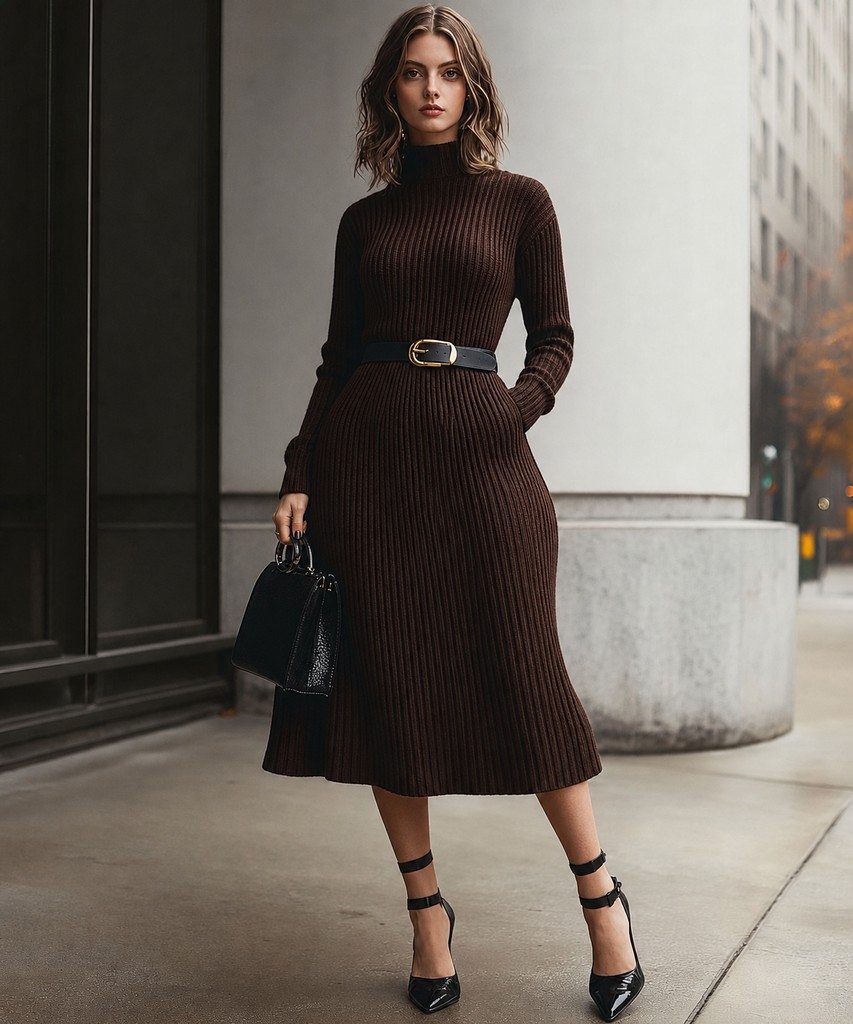
Try these looks on your shape
Stylin shows outfits on your body shape, styled from your own clothes — free on iOS.

Jackets and outerwear
Outerwear is a powerful tool for a pear figure because jackets and coats sit on the upper body, exactly where you want to build structure and width. The rule here is to add definition at the shoulder and end the jacket at the right point — the natural waist, not the hip.
Structured blazers
A structured blazer with a defined shoulder is one of the best outerwear pieces for a pear figure. The shoulder line widens the top of the silhouette, the lapels draw the eye up, and a nipped waist marks your narrowest point. Look for a blazer that ends at or just below the waist rather than at the hip, with set-in (not dropped) shoulders. Detail at the shoulder — a slight pad, an epaulette, or a strong lapel — adds extra balance.
Cropped jackets
A cropped jacket that ends at or above the natural waist keeps all the visual weight on the upper body and leaves the waist visible. Denim jackets, cropped trenches, bomber-style jackets with structure, and short tailored jackets all work. The key is the hemline: it should sit at the waist or higher, never at the widest part of the hip.
Coats
For longer coats, choose a structured shoulder and a defined or belted waist, and let the coat skim over the hip. A belted trench or a tailored wool coat that nips at the waist and falls cleanly past the hip works well. Avoid coats that are fitted through the body and end right at the hip, and avoid heavy detail — large pockets, wide hems — at hip level.
Outerwear to avoid
- Jackets that end at the widest part of the hip — the hem draws a horizontal line across the fullest point
- Dropped-shoulder, oversized coats — these collapse the shoulder line and remove the upper-body structure a pear figure benefits from
- Coats with large patch pockets or detail at the hip — any embellishment at hip level adds bulk where you want less
- Funnel or narrow collars with no shoulder structure — these can make the upper body look narrower; a wide collar or strong lapel is more balancing
Fabrics: what skims well vs. what clings
For a pear figure, fabric choice differs between the top and the bottom of the body. On the bottom, you want fabrics that skim and have enough structure to float away from the hip and thigh. On the top, you have more freedom to use lighter, shinier, and more textured fabrics that add visual volume.
Fabrics that work well on the bottom
- Ponte — structured enough to skim the hip without clinging, with a clean matte finish. Excellent for trousers, pencil and A-line skirts.
- Wool blend and tailoring fabrics — hold their shape, drape cleanly, and have a matte surface that doesn't attract the eye. Ideal for tailored trousers and structured skirts.
- Medium-weight denim with a little stretch — follows the waist-to-hip curve without gaping, in a dark matte wash.
- Structured cotton and twill — enough body to hold an A-line or wide leg away from the thigh.
- Crepe — matte and fluid with good drape, excellent for wide-leg trousers and skirts that need to move without clinging.
Fabrics that work well on top
- Textured knits and ribbing — add visual volume to the upper body without bulk.
- Satin, silk, and subtle sheen — these attract light, which is exactly what you want on the top half to draw the eye upward.
- Structured fabrics for shoulders — a little body in a blazer or statement-sleeve top builds the shoulder line.
Fabrics to approach with caution on the lower body
- Thin, clingy jersey on the hip and thigh — traces every curve at the widest point
- Shiny or metallic fabrics on the bottom — reflect light and draw the eye to the hip
- Stiff, bulky fabrics that add volume at the hip — heavy tweed or padded fabrics on the lower body add width where you want less
- Distressed or faded denim across the hip — light patches act as a spotlight on the fullest point
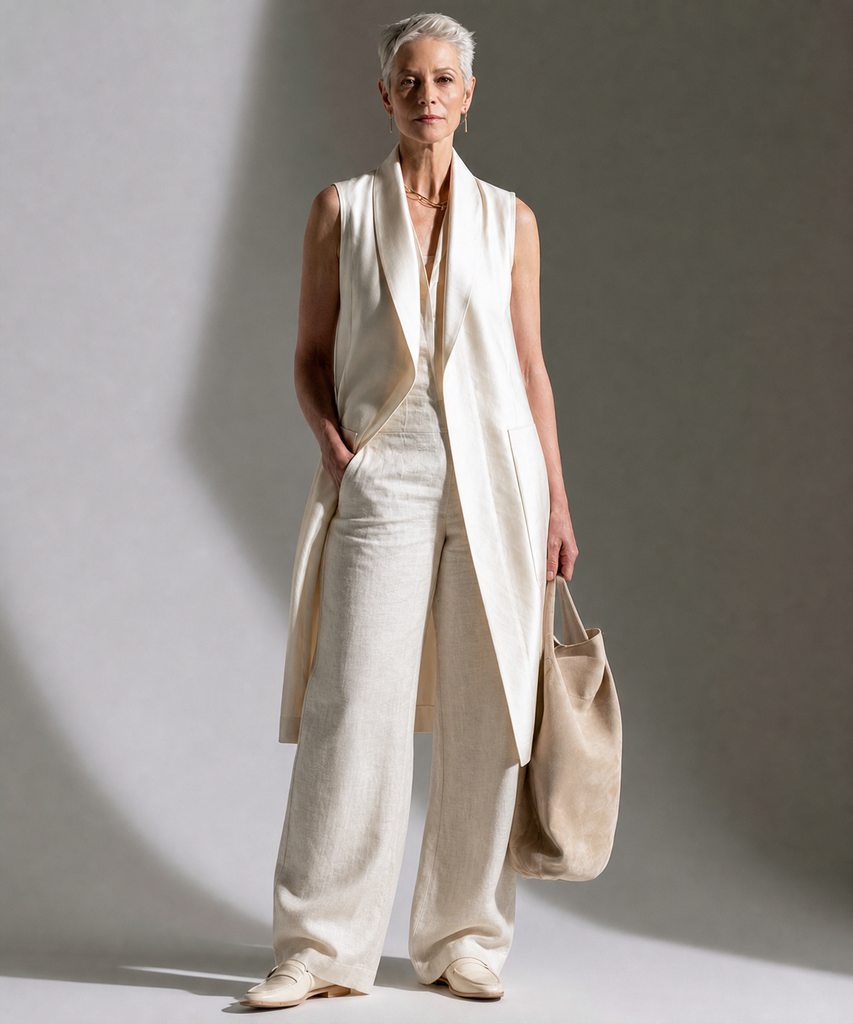
Occasion-specific outfit formulas
Theory is only useful when it translates into specific outfits. Here are four complete formulas — each a concrete prescription rather than a vague guideline.
Work outfit formula
Top: fitted boat-neck or structured blouse with a defined shoulder, in a light or mid tone — ivory, soft blue, blush
Bottom: high-waisted straight-leg or bootcut trousers in a dark matte ponte or wool blend — navy, charcoal, black
Outerwear: structured single-button blazer with a defined shoulder, ending at the waist
Shoes: pointed-toe pumps or block-heel ankle boots in a tone close to the trouser, to extend the leg line
One statement: earrings or a scarf at the neckline to keep attention high
Why it works: the boat neck and structured blazer build the shoulder, the dark matte trouser skims the hip, and the colour contrast keeps the brightness up top where you want the eye to land.
Casual / weekend formula
Top: bright or printed top with a wide or detailed neckline — a Bardot top, a striped boat neck, or a puff-sleeve blouse
Bottom: dark, matte straight-leg or bootcut jeans with no fading across the hip
Layer: a cropped denim or structured jacket worn open, ending at the waist
Shoes: white trainers, ankle boots, or flat mules
One statement: a colourful crossbody bag worn high, or earrings that draw the eye up
Why it works: the bright, detailed top and the cropped jacket keep all the interest on the upper body, while the dark matte denim quietly skims the lower half.
Evening formula
Option A (dress): fit-and-flare or A-line dress in a fluid fabric, with a detailed or off-shoulder neckline — a darker skirt with a brighter or embellished bodice is ideal
Option B (separates): a satin or embellished off-shoulder top + high-waisted wide-leg trousers in a matte dark fabric
Shoes: heeled sandals or pumps to elongate the leg
One statement: statement earrings or a shoulder-detail to keep the focus high; keep the clutch small
Why it works: the off-shoulder or embellished bodice broadens and lights up the upper body, while the flared skirt or wide-leg trouser floats over the hip and lengthens the figure.
Smart casual formula
Top: fitted knit with a wide scoop or boat neck, or a tucked-in blouse with a statement sleeve, in a mid or bright tone
Bottom: high-waisted A-line midi skirt in a matte dark solid, or dark wide-leg trousers
Layer: a structured blazer ending at the waist, or a cropped trench
Shoes: ankle boots or pointed-toe flats in a tone close to the hem
One statement: a pendant necklace or earrings worn high to draw the eye up
Why it works: the wide neckline and structured layer build the shoulder, the A-line skirt defines the waist and skims the hip, and the matte dark bottom keeps the lower half quiet.
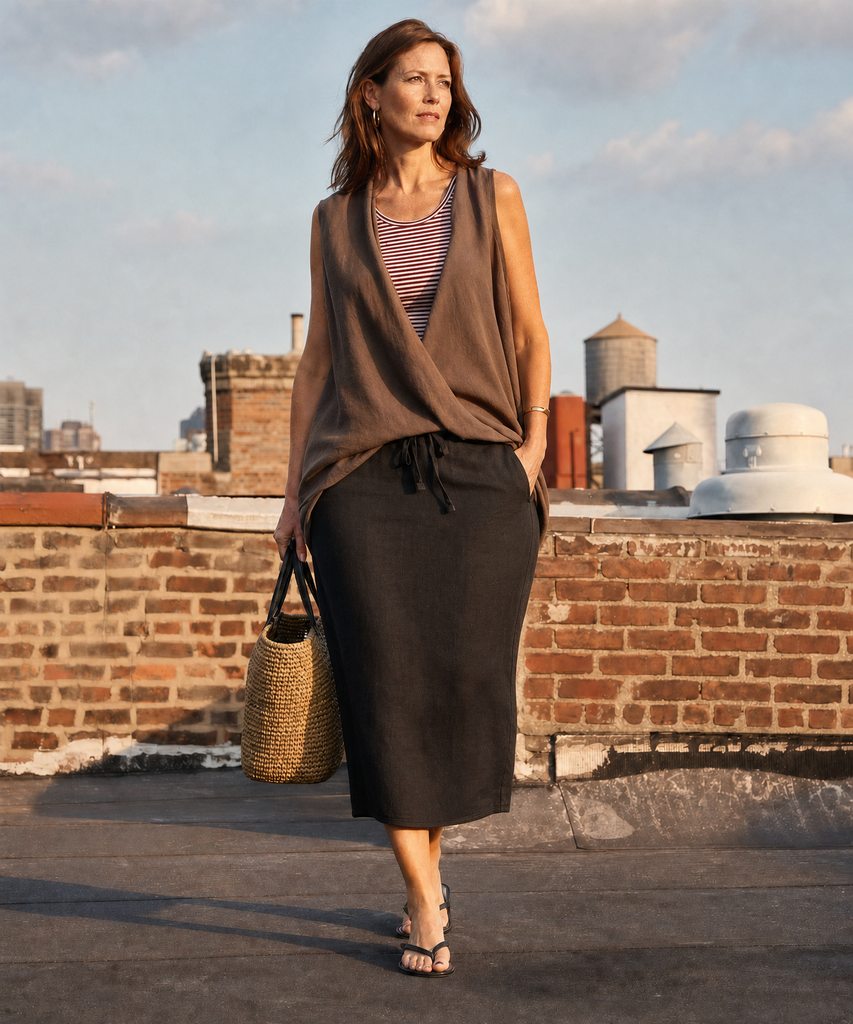
Common mistakes to avoid
Even with the best intentions, pear dressing regularly goes wrong in a predictable set of ways. Understanding why these mistakes work against the shape helps you spot and avoid them in the fitting room.
Hiding the whole body in shapeless clothing
The most common mistake is reaching for oversized, shapeless clothing in an attempt to hide the hips. The result is the opposite of balance: a shapeless outfit hides the defined waist — your strongest feature — and makes the whole figure read as larger than it is. The goal is to define the waist and balance the proportions, not to disappear under fabric.
Leaving the top half plain
A pear figure relies on the upper body to balance the lower, so a plain, narrow, dark top worn alone leaves the hip as the only point of interest. The fix is simple: add colour, pattern, structure, or a wide neckline up top. The top half should always be doing at least as much visual work as the bottom.
Spotlighting the hip with light or shiny fabrics
Light colours, shiny finishes, distressing, and large pockets on the lower body all attract the eye to the widest point. Keeping the bottom half matte and darker — and saving the brightness for the top — is one of the highest-impact adjustments available for a pear figure.
Jackets and tops that end at the widest point
A hemline that lands exactly on the fullest part of the hip draws a horizontal line precisely where you want to minimise width. Tops and jackets should end either at the natural waist (above the hip) or well below the hip — never right on it.
Tapered bottoms that exaggerate the hip
Trousers that narrow sharply at the ankle — pegged, tapered, or skinny in a light wash — exaggerate the contrast between a wide hip and a thin ankle, creating a top-heavy lower-body shape. A straight or bootcut leg keeps the line balanced from hip to floor.
How Stylin helps pear figures
Once Stylin identifies your body shape, it filters every outfit and shopping suggestion it makes through that lens — so you're not browsing a generic selection of recommendations but a curated set of combinations where the shoulder is built up, the waist is defined, and the lower body is kept clean and balancing. When new items are suggested to fill gaps in your wardrobe, those recommendations are pre-filtered to your shape as well.
Frequently asked questions
What exactly defines a pear body shape?
A pear (or triangle) shape is defined by hips that are noticeably wider than the bust and shoulders — typically more than about 5% larger — combined with a defined waist. Weight tends to settle on the hips, thighs, and bottom, while the upper body stays comparatively narrow. It occurs at every size and height.
How do I know if I have a pear body shape?
Take three measurements — bust at the fullest point, natural waist at the narrowest point, and hips at the fullest point. If your hips are more than about 5% larger than your bust and your waist is clearly narrower than your hips, you have a pear (triangle) shape. If your bust and hips are roughly equal instead, you are closer to an hourglass.
What is the difference between a pear and an hourglass shape?
Both have a defined waist, so the waist is not the deciding factor. An hourglass has a bust and hips within about 5% of each other; a pear has hips that clearly dominate a narrower bust and shoulders. The styling goal differs as a result — an hourglass emphasises balance that already exists, while a pear creates it by adding visual weight up top.
What is the main styling goal for a pear shape?
The goal is to balance the silhouette by drawing attention upward and adding visual width to the shoulders and bust, while keeping the lower body clean and streamlined. This evens out the proportions so the waist remains the focal point rather than the hips.
What necklines suit a pear body shape?
Boat necks, off-shoulder, square necks, and wide scoop necks all broaden the shoulder line and draw the eye upward, which balances wider hips. Horizontal detail at the neckline — like a Bardot top or a statement collar — is genuinely helpful here, the opposite of the advice given to broader-shouldered shapes.
What are the best trousers for a pear shape?
Straight-leg, bootcut, and wide-leg trousers in a dark, matte fabric work best because they skim the hip and thigh and create a long clean line to the floor. A bootcut or wide leg balances the hip by adding a small amount of width lower down. Avoid skinny jeans in light or shiny fabrics, which cling to the widest point.
What dress styles flatter a pear figure?
Fit-and-flare and A-line dresses are ideal: they define the waist and skim over the hips without clinging. Wrap dresses work well too. Look for interest at the top — a detailed neckline, puff sleeve, or patterned bodice — paired with a plain, darker skirt section.
Can a pear shape wear skinny jeans?
Yes, with the right styling. Choose skinny jeans in a dark, matte denim with no fading across the hip and thigh, and balance them with a top that adds volume or interest up top — a structured shoulder, a longer tunic, or a bright colour. The issue is never the skinny jean itself but pairing it with a plain fitted top that leaves the lower body as the focal point.
Should a pear shape avoid prints on the bottom?
Generally, keep bold prints, light colours, and shiny fabrics on the top half where you want to attract the eye, and keep the bottom half in darker, matte solids. This is a guideline rather than a rule — a print on the bottom can work if it is small-scale and dark-toned, or if you deliberately want to make a statement with your lower half.
What jackets work for a pear body shape?
Structured blazers with shoulder definition, cropped jackets that end at or just above the waist, and pieces with detail at the shoulder or lapel all help broaden the upper body. The jacket should end at the natural waist rather than at the widest part of the hip — a hem that lands on the hip emphasises width exactly where you want to minimise it.
What fabrics work best for a pear shape?
On the bottom, choose matte fabrics with enough structure to skim rather than cling — ponte, wool blend, structured cotton, and medium-weight denim. On top, fabrics can be lighter, shinier, and more textured to add visual volume. Avoid clingy, thin, or shiny fabrics on the hips and thighs, as they highlight the widest point.
How should a petite pear shape dress?
The goal is unchanged — draw attention upward and keep the lower half clean — but the margins are tighter. Cropped and tucked tops matter more, because a top that ends mid-hip on a taller frame ends at the widest point on yours. Keep trousers full-length and as close to one continuous colour with your shoes as you can manage; a break at the ankle costs a petite pear more than it costs anyone else. Add your interest at the neckline rather than the shoulder line, since heavy shoulder detail can overwhelm a smaller frame instead of balancing it.
What swimwear works for a pear body shape?
Put the detail on top and keep the bottom half plain. A patterned, ruffled or brightly coloured top against a solid dark bottom does exactly what the rest of a pear-shape wardrobe does — it moves the eye up and lets the hip recede. For bottoms, high-leg cuts lengthen the leg and skim the widest point, while boyshorts and low-rise ties tend to cut straight across it. One-pieces with a plunging or wrap neckline work well, and a wide-strapped or halter top adds visual width across the shoulders, which is the quickest way to bring the two halves into balance.
Knowing your shape is the straightforward part — the challenge is consistently applying it across an entire wardrobe and across every occasion, mood, and budget. Stylin learns your shape and taste, then builds outfits from what you already own and fills gaps with shopping picks calibrated to fit your proportions — all surfaced through the app's body-shape outfit feed.