
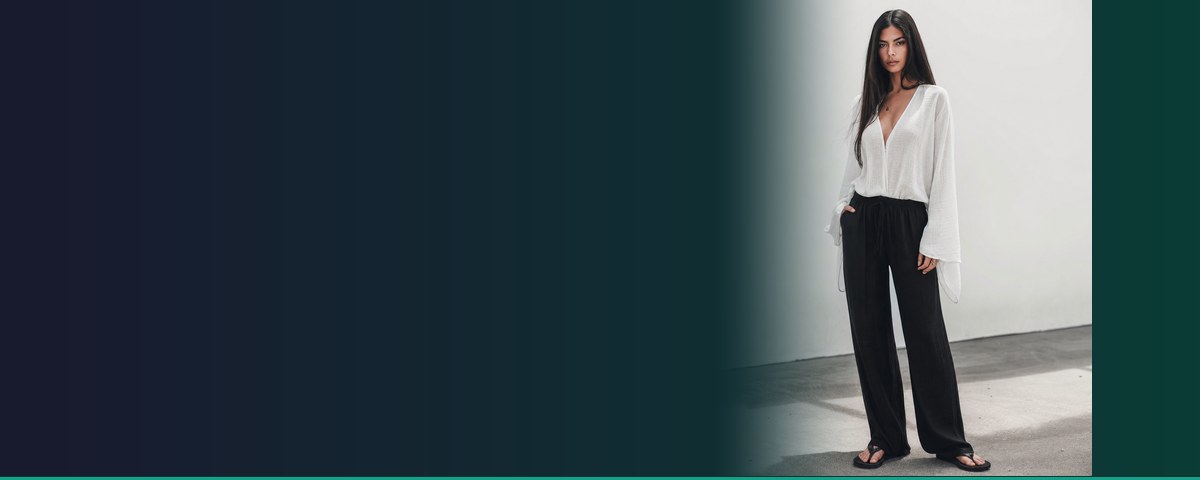
If your shoulders and bust are the widest part of your body, your hips are comparatively narrow, and your waist is only gently defined, you most likely have an inverted triangle body shape — sometimes called a "V" or athletic shape. It's the silhouette of many athletes, dancers, and swimmers, and the styling goal is the mirror image of the pear: balance the proportions by adding visual volume to the lower body while softening the shoulder line.
This guide goes deep. You'll find a precise definition of the shape, common misconceptions, celebrity outfit breakdowns that explain why specific looks work, and section-by-section recommendations covering every category from tops to outerwear — including what to avoid and why. At the end are four occasion-specific outfit formulas and a detailed FAQ.
What exactly defines an inverted triangle body shape
Stylists and clothing researchers define the inverted triangle shape using proportional measurements rather than absolute sizes. The three markers are:
- Shoulders and/or bust are the widest point — noticeably broader than the hips, typically by more than 5% in circumference
- Hips are comparatively narrow — the lower body is slim and straight, often with slender legs
- The waist is only gently defined — the curve from shoulder to waist is modest, so the silhouette reads as broad on top and tapering down
To measure yourself: take your shoulders and bust at the widest point, your natural waist, and your hips at the fullest point. If your shoulder or bust measurement is more than about 5% larger than your hips, and your lower body is comparatively narrow, you have an inverted triangle shape. The defining feature is that the upper body carries more visual weight than the lower body.
Common misconceptions about the inverted triangle shape
The most persistent misconception is that broad shoulders are unflattering or "masculine." They are not — strong shoulders are a striking, elegant feature, and the styling approach is about balance, not apology. The aim is to bring the hips into proportion with the shoulders so the figure reads as even, while letting the upper body's natural strength be an asset, especially in eveningwear.
The second misconception is that an inverted triangle should always hide the shoulders. You don't need to cover up — you simply avoid adding width up top (shoulder pads, puff sleeves, boat necks) and instead build volume below. A bare shoulder in a clean column dress can look spectacular on this shape; the issue is only horizontal width at the shoulder, not exposure.
A third common error: confusing the inverted triangle with the apple or rectangle shape. An inverted triangle's defining feature is specifically the shoulder-to-hip ratio — broad on top, narrow below. An apple carries weight around the midsection with a less defined waist, and a rectangle is straight up and down with similar measurements throughout. If your shoulders clearly dominate your hips, you're an inverted triangle, and the styling goal is to add volume down low.
Celebrity examples: outfit analysis
The most practical way to understand why certain cuts and silhouettes work for an inverted triangle figure is to study how they look on people with well-documented proportions. What follows are six celebrity case studies, each analyzing a specific type of look and why it succeeds anatomically.
Angelina Jolie — the V-neck column
Angelina Jolie, who has broad shoulders balanced by slim hips, frequently chooses column gowns with a deep V-neckline. The V does two things at once: it narrows the visual width of the shoulders by drawing two converging lines toward the centre of the chest, and it elongates the upper body. The column silhouette skims the slim lower body without adding the volume that would otherwise be ideal — which works on the red carpet precisely because the deep V already does the balancing. The lesson: a V-neck is the single most reliable neckline for an inverted triangle, because it counteracts width at the shoulder more effectively than any other detail.
What to replicate: V-neck and plunge necklines in dresses and tops. The deeper and narrower the V, the more it narrows the shoulder line. Pair with a bottom that adds a little volume for everyday balance.
Naomi Campbell — the full and flowing skirt
Naomi Campbell, with the strong shoulders of a runway model, often balances her silhouette with full, flowing skirts and wide-leg trousers. A full skirt adds volume at the hip and below, building up the narrow part of her figure until it visually matches the shoulders. The movement and width of the fabric lower down draw the eye downward and create the impression of an hourglass. The lesson: volume on the bottom — a full skirt, a wide leg, a flared hem — is the most direct way to balance broad shoulders, and it's exactly the volume a pear figure would avoid.
What to replicate: full A-line and pleated skirts, wide-leg and palazzo trousers, and flared hems. Choose fabrics with enough body to hold their volume away from the leg.
Renée Zellweger — the soft, narrow shoulder
Renée Zellweger tends to choose tops and dresses with soft, narrow, or raglan shoulders rather than structured ones. By avoiding any horizontal line or padding at the shoulder and letting the fabric fall softly from a narrower shoulder seam, the upper body reads as more compact. Combined with simple, dark tops, this de-emphasises the shoulder so the rest of the outfit can do the balancing. The lesson: softening the shoulder — through raglan or dropped sleeves, narrow seams, and fluid fabrics — is as useful as adding volume below.
What to replicate: tops with raglan or dropped sleeves, soft set-in shoulders, and fluid fabrics that fall close to the body. Avoid anything that builds or squares the shoulder.
Cameron Diaz — colour and print on the bottom
Cameron Diaz, an athletic inverted triangle, frequently flips the usual colour rule: she places the brighter colour, the print, or the detail on the lower half of an outfit and keeps the top darker and plainer. The eye goes first to the brightest, busiest part of an outfit, so anchoring that at the hip and below draws attention downward and adds perceived volume to the narrow lower body. The lesson: for an inverted triangle, colour and pattern belong on the bottom — the opposite of the advice a pear figure receives.
What to replicate: printed or brightly coloured skirts and trousers under plain, dark tops. When you want pattern up top, keep it small and dark, and add something stronger below.
Demi Moore — high-waisted volume and the defined waist
Demi Moore often uses high-waisted, fuller bottoms — wide-leg trousers and full skirts that sit at the natural waist. The high waist creates a defined waistline where the shape doesn't naturally have a strong one, and the fuller leg or skirt adds the lower-body volume that balances the shoulders. Together they manufacture an hourglass read from an inverted triangle base. The lesson: a high waist plus lower-body volume both defines the waist and balances the shoulders in a single move.
What to replicate: high-waisted wide-leg trousers and full high-waisted skirts, paired with a top tucked in at the waist. The high waistband marks the narrowest point and the volume below evens out the proportions.
Gisele Bündchen — the clean, narrow top half
Gisele Bündchen, tall with athletic shoulders, builds many off-duty looks around a simple, narrow, uncluttered top half — a fitted V-neck tee, a fine-knit sweater, a plain tank — over fuller or detailed bottoms. Keeping the top clean and close to the body avoids adding any width or bulk to the shoulder, letting the lower-body interest balance the figure. The lesson: the top half should generally be the quiet part of the outfit for an inverted triangle, with the detail saved for below the waist.
What to replicate: fitted, simple V-neck and scoop tops in plain, darker tones, worn with fuller or detailed bottoms. Resist the urge to add embellishment, volume, or horizontal lines up top.
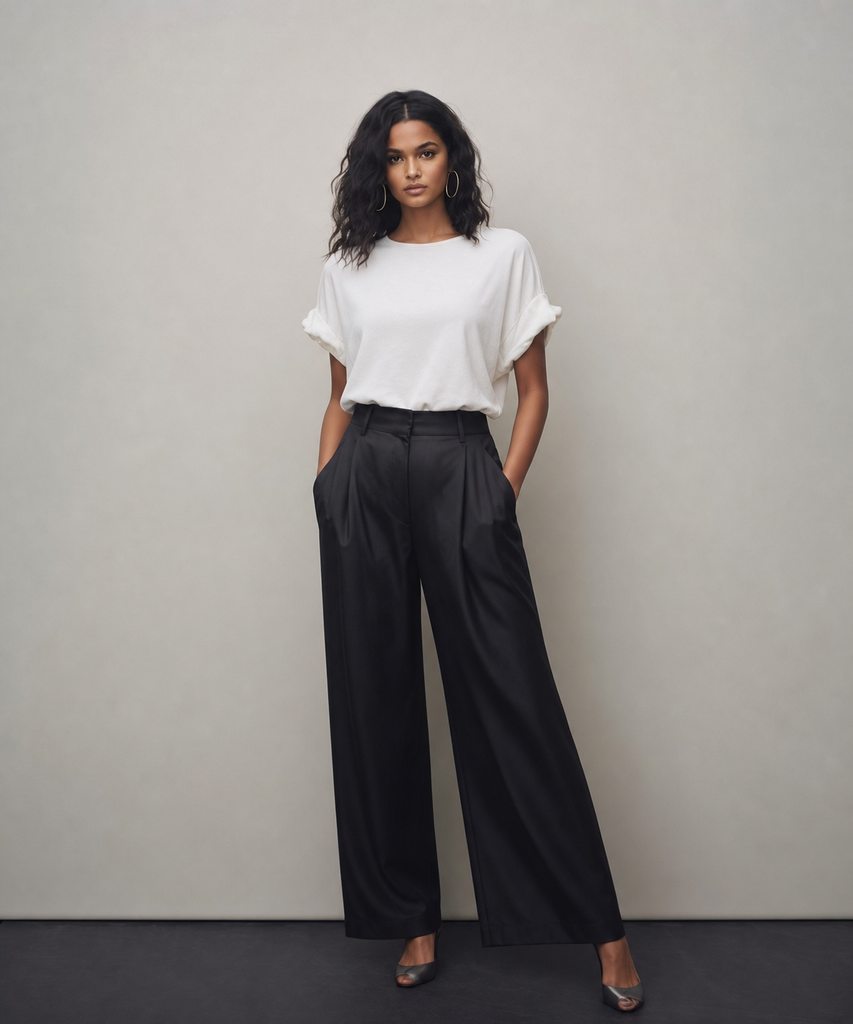
Tops that work for inverted triangle figures
For an inverted triangle, the top half is where you minimise width and keep things clean. The fundamental requirement is that a top should narrow or soften the shoulder line and avoid adding bulk up top. Here is a category-by-category breakdown:
V-necks and deep necklines
The V-neck is the most reliable top for an inverted triangle. By drawing two lines that converge toward the centre of the chest, it visually narrows the shoulders and elongates the upper body. Scoop necks, sweetheart, and plunge necklines work on the same principle. The deeper and narrower the neckline, the more it counteracts shoulder width. These are effective in fitted and semi-fitted tops alike.
Raglan and dropped sleeves
A raglan sleeve runs diagonally from the underarm to the neckline rather than meeting a vertical shoulder seam, which softens and narrows the shoulder line. Dropped shoulders — where the seam falls below the natural shoulder — also reduce the apparent width up top. Both are the inverse of the structured shoulder a pear figure wants, and both are quietly useful for an inverted triangle.
Dark, plain, fitted tops
A simple, darker, close-fitting top keeps the upper body quiet so the lower body can do the balancing. Fine knits, plain tees, and fitted tanks in solid, muted tones all work. Keep embellishment, print, and horizontal detail off the top half — save them for below the waist.
Tops with waist detail
Because the inverted triangle's waist is often only gently defined, a top that marks the waist helps create curve. A peplum top adds a little volume at the hip — which is welcome here, the opposite of most shapes — and defines the waist at the same time. Wrap tops and tops with a tie or seam at the waist also help carve out a waistline.
Tops that work against an inverted triangle figure
- Boat necks and off-shoulder tops — these run horizontally across the shoulders and broaden the widest point of the body
- Shoulder pads and structured shoulders — any padding or squaring adds width exactly where you don't want it
- Puff, balloon, and statement sleeves — volume at the shoulder and upper arm exaggerates the broad upper body
- Halter necks — these emphasise and widen the shoulders and upper back
- Horizontal stripes, embellishment, or bold prints across the chest — any horizontal interest up top adds visual width to the shoulders and bust
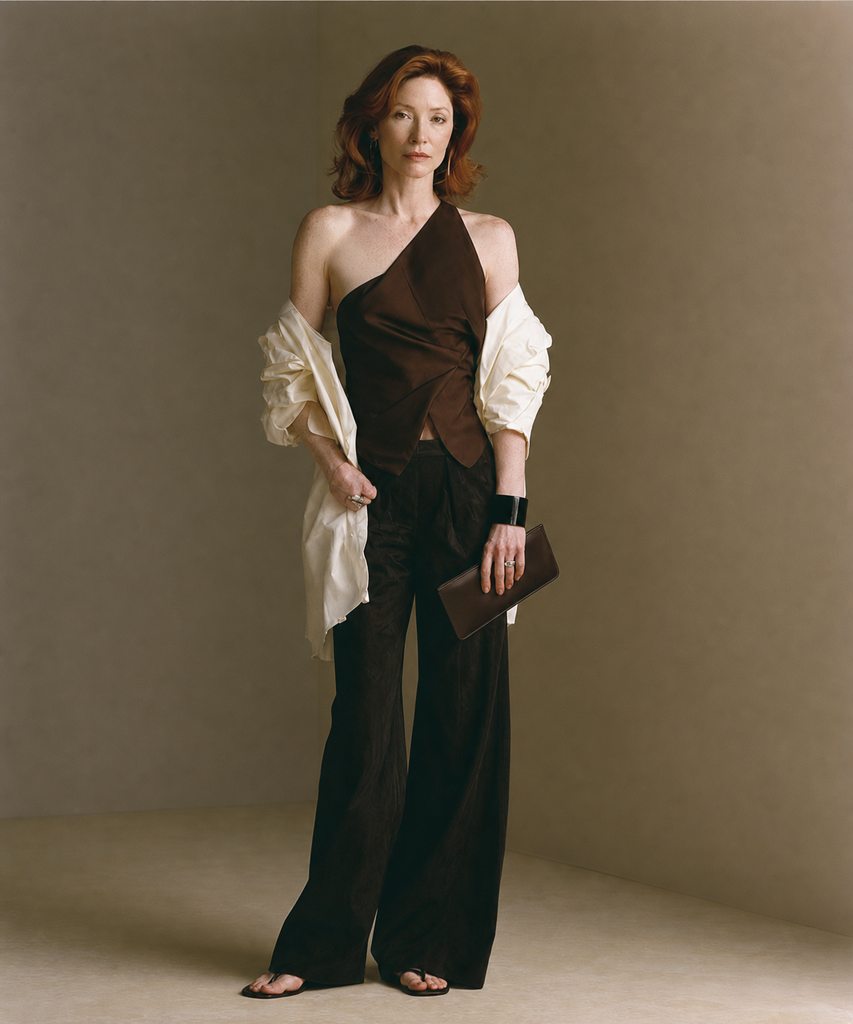
Bottoms that flatter an inverted triangle figure
The unifying principle for all bottoms on an inverted triangle is the reverse of the pear: add volume, detail, and width to the lower body so it balances the broad shoulders. This is the half of the outfit where you can be bold with cut, colour, and pattern.
Wide-leg and palazzo trousers
Wide-leg trousers add the most volume to the lower body, building it up until it balances the shoulders. High-waisted wide-legs in a fabric with movement create a full, elegant line that evens out the silhouette. Palazzo trousers take this further for eveningwear. Pair with a fitted top to define the waist. This is the single most balancing trouser shape for an inverted triangle.
Flared and bootcut trousers
Flared and bootcut trousers add width at the hem, which draws the eye downward and balances the upper body. A full 1970s flare is particularly effective; a bootcut is the more everyday version. Both work best high-waisted and in fabrics with some body. The widening leg is exactly the detail an inverted triangle benefits from.
Jeans with detail and lighter washes
For denim, an inverted triangle can do what most shapes are told to avoid: choose lighter washes, whiskering, distressing, and hip detail, all of which add visual volume to the lower body. Bootcut and flared cuts balance best. Skinny and straight jeans can work if you add volume elsewhere — a longer top at the hip, ankle boots, or a fuller shoe.
Skirts
- A-line and full skirts: the ideal skirts for an inverted triangle. The volume from the waist down builds the hip and balances the shoulders. A pleated or gathered full skirt is especially effective.
- Pleated skirts: pleats add structured volume and movement to the lower body, balancing the upper body while defining the waist at the top.
- Pencil skirts with detail: a pencil skirt works when it has hip detail, a peplum, or a print to add volume; a plain pencil skirt is less balancing because it follows the narrow hip.
- Maxi and midi skirts: fuller maxi and midi skirts in fabrics with body add length and lower-body volume. Choose styles that flare rather than cling.
Bottoms to avoid
- Tapered and pegged trousers — narrowing at the ankle makes the lower body look even slimmer, exaggerating the contrast with the shoulders
- Plain, dark, narrow bottoms worn with a plain top — this leaves the shoulders as the unbalanced focal point
- Very slim, clingy bottoms with no detail — they emphasise how narrow the lower body is relative to the shoulders
- Low-rise styles — these reduce the chance to define the waist and shift attention away from the lower body
Dresses and jumpsuits for an inverted triangle figure
Dresses work well for an inverted triangle when they keep the top half clean and add volume below. A well-designed dress can narrow the shoulder, define the waist, and build the lower body all at once.
Fit-and-flare dresses
Fit-and-flare is a classic for the inverted triangle. The bodice skims the upper body and the skirt flares from the waist, adding the lower-body volume that balances broad shoulders. Look for a V-neck or scoop neckline and minimal shoulder detail, with a skirt that has enough body to hold its flare. This silhouette manufactures an hourglass read from an inverted triangle base.
A-line dresses
An A-line dress flares gently and evenly, adding width to the lower body. Paired with a narrow, V-shaped neckline up top, it balances the shoulders and creates the impression of a curve at the waist. It's one of the most universally flattering dress shapes for this figure.
Dropped-waist dresses
Unusually, the dropped-waist dress — which most shapes are steered away from — can work well for an inverted triangle. By shifting the waist seam and the volume downward to the hip, it draws the eye to the lower body and de-emphasises the shoulders. Choose one with a soft, narrow shoulder and let the volume sit at the hip and below.
Wrap dresses
A wrap dress creates a V-neckline that narrows the shoulders and ties at the waist to define it. Look for a version with an A-line or fuller skirt to add lower-body volume, and a soft shoulder. The V plus the waist tie plus a flared skirt together address every part of the inverted triangle styling goal.
Jumpsuits
Jumpsuits work for an inverted triangle when they have a V or scoop neckline, a soft shoulder, a defined waist, and a wide or flared leg. The wide leg is key — it adds the lower-body volume that balances the shoulders. Avoid jumpsuits with halter necks, structured shoulders, or narrow tapered legs.
Dresses and silhouettes to approach with caution
- Halter and one-shoulder dresses with structure — these emphasise and broaden the shoulder line
- Dresses with heavy shoulder embellishment or puff sleeves — they add width and detail to the widest point
- Straight shift and column dresses with no lower-body volume — these can leave the shoulders unbalanced unless rescued with a deep V; otherwise they trace a narrow lower body
- Bodycon dresses that cling to a narrow hip — they exaggerate the contrast between broad shoulders and slim hips
Style your shape with what you own
Stylin builds outfits shown on your body shape, from your own wardrobe — free on iOS.

Jackets and outerwear
Outerwear needs the most care for an inverted triangle, because jackets and coats sit on the upper body and are often built with structured shoulders — exactly the width you want to avoid. The rule here is to keep the shoulder soft and narrow and let any volume fall lower down.
Soft-shoulder and unstructured jackets
Choose jackets with soft, unpadded, or narrow shoulders that fall close to the body. An unstructured blazer in a fluid fabric, a soft-shoulder cardigan-jacket, or a draped open jacket all avoid adding width up top. The shoulder seam should sit at or just inside your natural shoulder, never extended or padded.
Longline and A-line coats
A longline coat that falls in a column or flares slightly toward the hem adds length and a touch of lower-body volume, drawing the eye downward. An A-line or swing coat is particularly balancing because the volume sits at the hip and below. Keep the shoulder soft and the collar narrow.
Belted coats
A belted coat defines the waist — useful for a shape that doesn't have a strong natural waistline — and a coat that flares below the belt adds lower-body volume. Look for a soft shoulder and a skirt that releases from the waist rather than a structured, square upper body.
Outerwear to avoid
- Structured, padded, or military shoulders — epaulettes, shoulder pads, and squared seams all broaden the widest point
- Double-breasted coats with wide lapels — the horizontal button rows and wide lapels add visual width across the chest and shoulders
- Cropped, boxy jackets that end at the waist — these emphasise the broad upper body and leave the lower body unbalanced; choose longer or A-line shapes instead
- Funnel necks and large collars — bulk around the neck and shoulders adds width up top
Fabrics: what minimises up top vs. what adds volume below
For an inverted triangle, fabric choice differs between the top and the bottom of the body — the inverse of the pear. On the top, you want soft, matte fabrics that fall close to the body without adding bulk. On the bottom, fabrics can have more body, texture, and structure to build the volume that balances the shoulders.
Fabrics that work well on top
- Fine knits and jersey — fall close to the body and keep the upper half streamlined without adding bulk.
- Fluid blouses and silk-like fabrics — drape softly from the shoulder, avoiding any structure or width.
- Matte, darker fabrics — recede visually, helping de-emphasise the shoulders.
Fabrics that work well on the bottom
- Fuller, structured fabrics for skirts — cotton with body, ponte, and mid-weight wovens hold an A-line or pleated shape that adds volume.
- Textured and pleated fabrics — texture and pleating add visual and physical volume to the lower body.
- Lighter colours, prints, and sheen on the bottom — these attract the eye downward and build up the narrow lower body.
- Crepe and fluid fabrics for wide-leg trousers — create movement and width through the leg.
Fabrics to approach with caution on the upper body
- Stiff, structured fabrics on top — heavy tweed or canvas builds the shoulder and adds width
- Shiny or metallic fabrics on the shoulders and bust — they catch light and broaden the widest point
- Bulky, chunky knits up top — they add significant volume to the shoulders; save chunky texture for the lower body or a long cardigan
- Heavily textured or embellished fabrics across the chest — these add visual width where you want less
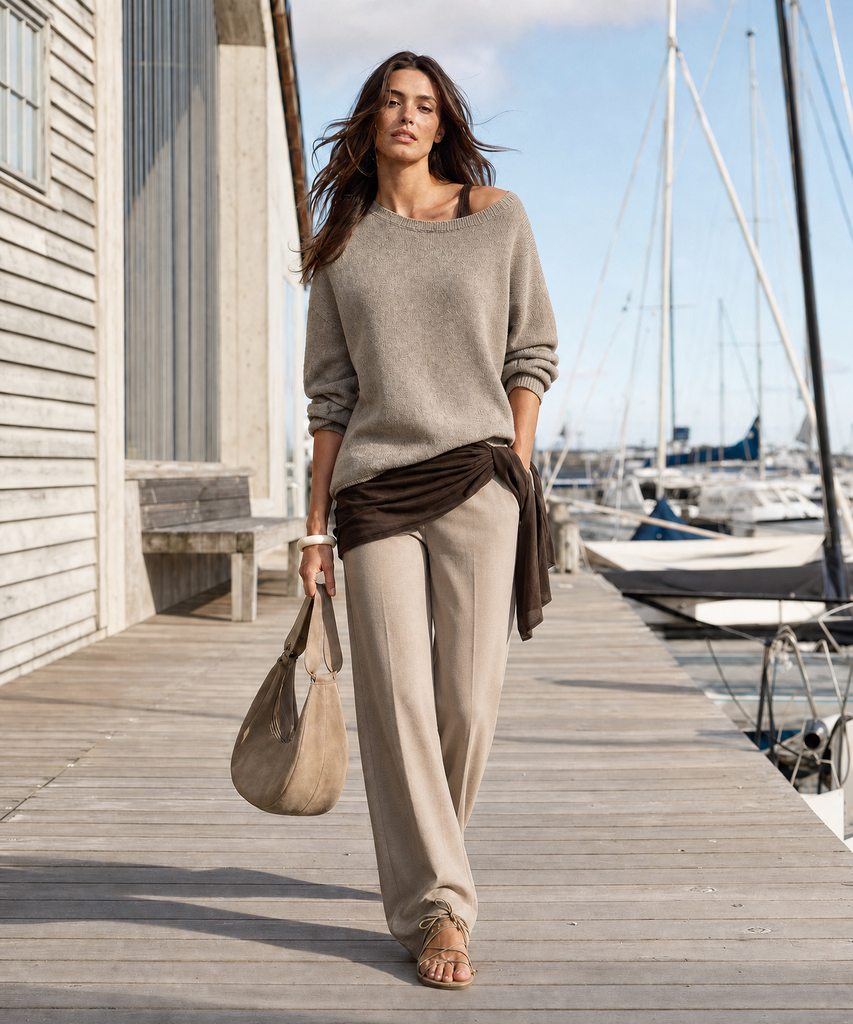
Occasion-specific outfit formulas
Theory is only useful when it translates into specific outfits. Here are four complete formulas — each a concrete prescription rather than a vague guideline.
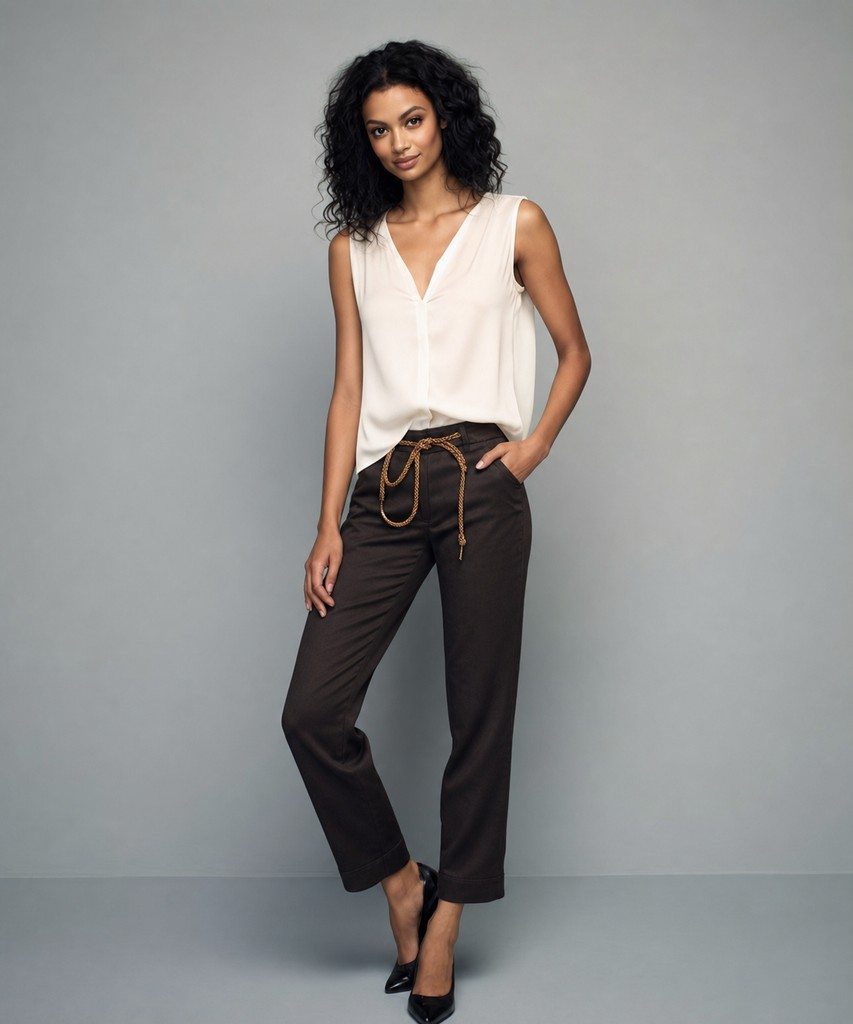
Work outfit formula
Top: fitted V-neck shell or soft-shoulder blouse in a dark or muted tone — navy, charcoal, deep green
Bottom: high-waisted wide-leg or bootcut trousers, optionally in a lighter tone or subtle pattern
Outerwear: soft, unstructured blazer with a narrow shoulder, worn open
Shoes: block-heel or pointed pumps; a slightly heavier shoe adds welcome lower-body weight
One statement: a pendant necklace sitting in the V to draw the eye to the centre
Why it works: the V-neck and soft blazer narrow the shoulders, while the wide-leg trouser and any lower-body colour add the volume that balances the upper body.
Casual / weekend formula
Top: plain fitted V-neck tee or fine knit in a dark, solid tone
Bottom: flared or bootcut jeans, or a printed/lighter-wash denim with hip detail
Layer: a long, soft cardigan or open longline jacket that falls past the hip
Shoes: ankle boots or chunky trainers that add weight at the foot
One statement: a printed or coloured bag worn low, or detail at the hip
Why it works: the plain dark top keeps the shoulders quiet, the flared denim and longer layer add lower-body volume, and the heavier shoe anchors the eye downward.
Evening formula
Option A (dress): fit-and-flare or A-line gown with a deep V-neck and a full or detailed skirt, in a fluid fabric
Option B (separates): a simple dark V-neck top + high-waisted palazzo or wide-leg trousers in a luxe fabric, or a full statement skirt
Shoes: heeled sandals or pumps to elongate the leg
One statement: drop earrings or a detail at the hem; keep the shoulders clean and unembellished
Why it works: the deep V narrows the shoulders while the full skirt or wide-leg trouser builds the lower body, reflecting light and creating an hourglass read in evening settings.
Smart casual formula
Top: fine-knit V-neck or scoop top in a muted, darker tone, softly fitted
Bottom: high-waisted A-line or pleated midi skirt, in a lighter colour, print, or texture
Layer: a soft, unstructured longline jacket or belted coat with a flared hem
Shoes: ankle boots or loafers with a little weight
One statement: a pendant in the neckline, or detail at the skirt
Why it works: the V-neck and soft layer narrow and soften the shoulders, the A-line or pleated skirt defines the waist and adds lower-body volume, and the colour or texture below draws the eye downward.
Common mistakes to avoid
Even with the best intentions, inverted triangle dressing regularly goes wrong in a predictable set of ways. Understanding why these mistakes work against the shape helps you spot and avoid them in the fitting room.
Adding width to the shoulders
The most common mistake is choosing details that broaden the shoulders — shoulder pads, puff sleeves, boat necks, halter necks, and structured jackets. Each adds width to the part of the body that is already the widest, throwing the silhouette further out of balance. The fix is to keep the shoulder soft, narrow, and clean, and to reach for V-necks and raglan sleeves instead.
Keeping the lower body too plain and narrow
An inverted triangle relies on the lower body to balance the upper, so plain, dark, narrow bottoms leave the shoulders as the unbalanced focal point. The fix is the reverse of pear advice: add volume, colour, pattern, and detail below the waist. The lower half should be doing at least as much visual work as the top.
Placing colour and print on top
Bright colours, prints, and embellishment on the upper body draw the eye to the shoulders and bust — the widest point. Saving the brightness and pattern for the lower body, and keeping the top in darker, plainer tones, is one of the highest-impact adjustments available for this shape.
Ignoring the waist
Because the inverted triangle's waist is often only gently defined, it's easy to let outfits read as straight up and down. High-waisted bottoms, belted styles, and tops that mark the waist all carve out a waistline and help create the impression of curve.
Tapered bottoms that exaggerate the contrast
Trousers that narrow at the ankle make the lower body look even slimmer relative to the shoulders, exaggerating the imbalance. A wide, flared, or bootcut leg keeps the proportions even from waist to floor.
How Stylin helps inverted triangle figures
Once Stylin identifies your body shape, it filters every outfit and shopping suggestion it makes through that lens — so you're not browsing a generic selection of recommendations but a curated set of combinations where the shoulder is softened, the waist is defined, and the lower body is built up to balance broad shoulders. When new items are suggested to fill gaps in your wardrobe, those recommendations are pre-filtered to your shape as well.
Frequently asked questions
What exactly defines an inverted triangle body shape?
An inverted triangle shape is defined by shoulders and/or a bust that are noticeably wider than the hips — typically by more than about 5% — with a lower body that is comparatively narrow and a waist that is often only gently defined. It is common in athletic builds and in women who carry width or muscle through the shoulders and back.
What is the main styling goal for an inverted triangle?
The goal is to balance the silhouette by adding visual volume and width to the lower body while softening or de-emphasising the shoulders and bust. This brings the hips into proportion with the upper body and creates the appearance of a defined waist.
What are the best bottoms for an inverted triangle?
Wide-leg, flared, and bootcut trousers, A-line and full skirts, and bottoms with detail — pockets, pleats, prints, or lighter colours — all add volume to the lower body and balance broader shoulders. High-waisted styles also help define the waist. This is the opposite of pear-shape advice, which keeps the bottom plain.
What necklines suit an inverted triangle?
V-necks, scoop necks, and deep necklines narrow and soften the shoulder line and draw the eye toward the centre of the body. Avoid wide boat necks, off-shoulder styles, and halter necks, which broaden shoulders that are already the widest point.
What dress styles flatter an inverted triangle?
Fit-and-flare and A-line dresses are ideal because they skim the upper body and add volume through the skirt, balancing broad shoulders. Look for a V-neck or scoop neckline, minimal shoulder detail, and a fuller or detailed lower half. Dropped-waist dresses can also work by shifting volume downward.
Should an inverted triangle avoid shoulder pads and puff sleeves?
Yes, generally. Shoulder pads, puff sleeves, structured shoulders, epaulettes, and boat necks all add width to shoulders that are already the widest part of the body. Choose set-in or slightly narrowed shoulders, raglan or dropped sleeves, and softer fabrics that fall close to the body up top.
Can an inverted triangle wear skinny jeans?
They can, but bootcut, flared, and wide-leg styles are usually more balancing because they add width to the lower body. If you wear skinny or straight jeans, balance them with volume elsewhere on the lower half — detail at the hip, a longer top that stops at the hip, or ankle boots that add visual weight at the foot.
Where should an inverted triangle place colour and print?
Place brighter colours, prints, and detail on the lower body to draw the eye downward and add visual volume to the hips, and keep the upper body in darker, plainer tones to de-emphasise broad shoulders. This is the reverse of the standard pear-shape guidance.
What fabrics work best for an inverted triangle?
On top, choose softer, matte fabrics that fall close to the body without adding bulk — fine knits, jersey, and fluid blouses. On the bottom, fabrics can have more body, texture, and structure — A-line skirts in fuller fabrics, textured or pleated trousers — to add the volume that balances the shoulders.
How should a petite inverted triangle dress?
The strategy stays the same — soften the shoulder line, build volume below — but you have less vertical room to spend on it. Choose bottoms with movement rather than bulk: a fluid wide-leg or a soft A-line adds the width you want without the fabric mass that shortens a smaller frame. Keep the waistband high and the leg long so the lower half reads as one uninterrupted stretch. Avoid stacking horizontal detail up top; a single open neckline does more for balance than a collar, a lapel and a shoulder seam competing at once.
What swimwear works for an inverted triangle body shape?
Reverse the usual advice and put the pattern on the bottom. A plain, well-supported top with a printed, ruffled or high-cut bottom adds visual width at the hip and evens out a broader shoulder line. V-necks, scoop necks and plunge fronts break up the chest and shoulders; halter necks and bandeaus do the opposite, pulling width straight across the top of the frame. Look for straps set wider apart rather than close to the neck, and skip anything with shoulder ruffles or heavy embellishment up top — it adds volume exactly where you're trying to take it away.
Knowing your shape is the straightforward part — the challenge is consistently applying it across an entire wardrobe and across every occasion, mood, and budget. Stylin learns your shape and taste, then builds outfits from what you already own and fills gaps with shopping picks calibrated to fit your proportions — all surfaced through the app's body-shape outfit feed.