
Say what you feel.
See what to wear.
Type a mood, a moment, anything — and get a curated feed of outfits that actually fit that feeling, each one with a reason why. In seconds.
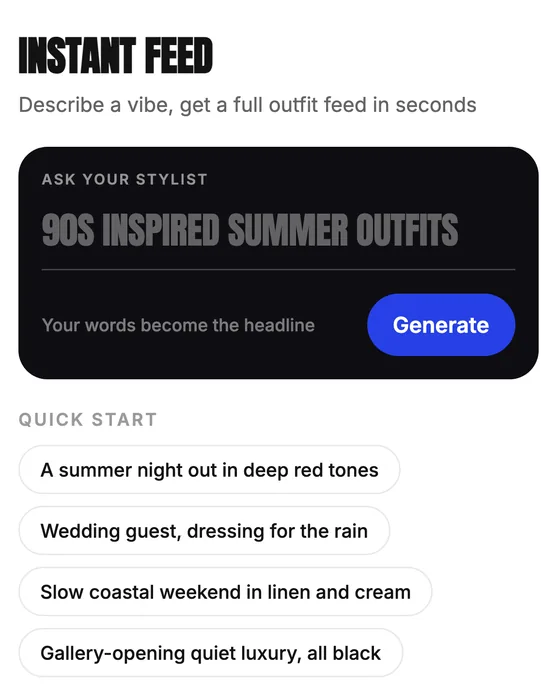
No category. No filter. Just say it.
People have tried these exact phrases — and walked away with a feed that felt like someone had read their mind:
None of these map to a garment keyword. They map to a feeling — an aesthetic, a context, a mood that sits somewhere between occasion and identity. Stylin reads all of that and finds the outfits that belong there.
What happens in those four seconds
It reads the room
Your words are interpreted for what they actually mean — the aesthetic, the formality, the occasion underneath. "Coastal grandmother vibes" becomes a fully formed concept before a single outfit is considered.
It finds what belongs
Thousands of looks are compared against both the meaning of your prompt and the aesthetic profile built in the first step. What surfaces isn't just relevant — it fits the texture of what you described.
It tells you why
Each of the top 10 outfits arrives with a one-sentence reason written specifically for your prompt and that specific look. Not a label. A thought.
From our engineers
Fashion search has always been keywords. "Blue jeans." "White linen shirt." It works — if you already know what you want. But "first date energy" is not a keyword. It is a feeling, an aesthetic shorthand for a dozen garment properties and occasion signals that the person typing it has never explicitly listed. The problem we had to solve was not search. It was translation.
The hard part is that the translation has to hold all the way through — from your words to a concept to a ranked list to a written reason per outfit. One weak link and the feed feels generic. We built each step to stay faithful to what you actually meant, not just what you literally said. That is the difference between a feed that surprises you and one that just fills a screen.
What you walk away with
- Ten outfits that genuinely fit what you described — not keyword matches, but looks that belong to the mood, occasion, and aesthetic you had in mind.
- A one-sentence reason for each look, written for your exact prompt and that exact outfit. The kind of thing a stylish friend says, not a tag on a product page.
- A name for the whole feed — "Quiet Luxury Sunday", "Off-Duty Minimal Power" — because sometimes the best part is finally having a word for the thing you were reaching for.
- Loading messages that tell you what's actually happening, not a spinner pretending nothing is.
- A feed that waits for you — step away, come back, it's still there.
- A "New vibe" button for when inspiration strikes again.
A few things people ask
What kinds of prompts actually work?
Most things do — a specific occasion ("job interview at a creative agency"), a mood ("cosy Sunday morning"), a pure aesthetic ("clean minimal, all neutral"). The more specific you are, the more the feed feels like it was made for you. Very short prompts like "nice outfit" still work, but there's less for the app to go on.
Why does each outfit come with an explanation?
Because "trust the algorithm" is not an experience. When a look appears and you read "unhurried linen silhouette — exactly the coastal grandmother ease you described," something clicks. You don't just see an outfit. You feel seen.
How is this different from the occasion feed?
The occasion feed is structured — you tap chips for work, outings, dating — and it's great for everyday use. The vibe feed is open-ended: you describe something in plain words, and it finds whatever fits that feeling, even if there's no chip for it. Different tools for different moments. For the morning decision specifically, see how AI solves the wardrobe problem.
You already know what you're looking for.
Just say it. Download Stylin free on iOS and see what shows up.